This article is a follow-up to my last article called “3 Keys to Building Muscle”. If you haven’t read that yet, read it first here then come back to read this one.
Bodybuilders who only bodybuild generally move like, well bodybuilders.
Their choice of exercises, reps, sets and frequency create their physiques but also leave them slower and less athletic than if they weren’t so focused on hypertrophy all the time.
But for the athlete who wants to increase their muscle mass, this approach won’t work.
Another factor causing high T in college-aged males.
One thing I must mention is that the strategies I talked about in my previous article aren’t necessary for the young college athlete whose gonads are pumping testosterone through their veins like gas stations pump fuel into SUVs on long weekends.
If you’re one of these guys, focus on lifting heavy things with big compound movements and you’ll grow. You probably don’t even need to eat very well, as thousands of college football players provide evidence for.
But if you’re 30+ and you’ve got a job, maybe a family, your T levels aren’t what they used to be, not to mention your recovery ability (which affects but is not completely explained by testosterone) AND you’re training martial arts or some other sport, you need a more refined approach to building mass than just lifting hard and heavy, because do that and sooner or later something will break.
I explained the approach to building mass in the 3 Keys to Building Muscle article which outlined the strategy behind the eXplosive Muscle Building Blueprint (xMB).
Now, I’m going to reveal the other side of the equation – the ‘x’ in xMB.
Add the strategies I talk about here to the 3 Keys and you’ll be able to at the very least, maintain your current level of absolute speed/power, which is actually a relative increase, since you’ll be gaining weight at the same time.
However, most of you who follow this blueprint will probably also increase absolute speed/power because all of the muscle you do add will be trained for explosiveness right from the get go.
It’s all actually quite simple, really, here’s how to do it:
After your warmup but before you get into your hypertrophy training, you start your workout with functional movements focused specifically on maximal speed/power.
Kris Kross ‘ll make ya…
Functional refers to whatever is functional for your sport, not single leg jumps off a Bosu ball, unless you’re a surfer practising bailing off your board.
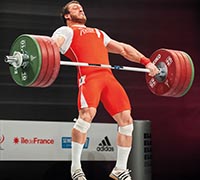
For MMA, the movements most important would be explosive lower body movements such as Squat or Lunge Jumps (and their variations) for things like takedowns, Olympic lifts, and rotational movements that will help with striking. Many of you already know my fave rotational movements and they involve whipping a medicine ball around.
Doing this before you stimulate your muscles for growth is important because both your nervous system and your muscles are fresh and thus capable of maximal activation, training your now bigger muscles for max speed and power.
The other point that must be made is about general speed/power training – you need multiple short sets and full rest to ensure this system is being maximized and the neural integration occurs.
Sets that last more than 12-15 seconds start to tap into the lactic system, which we want for hypertrophy, but don’t want for speed/power.
Sufficient rest (more rest is needed for exercises closer to the strength side of the speed-strength continuum) is usually a bare minimum of 60 seconds, but I tend to take more just to make sure I’m putting 100% into each set.
In terms of how I periodize this approach in xMB, I start with concentric dominant exercises that won’t result in much if any muscle soreness so your MMA training (or other sport) can continue with minimal impact.
After 4 weeks of this type of training, you’ll transition to exercises that train the stretch-shortening cycle and since you’ve progressed intelligently to them, soreness again will be minimized.
You see, that’s one of the main goals I had when creating xMB and I believe at least for the guys who I mentioned would best be served by this approach, it’s the best approach available.
So get started today and add 7-9 lbs of functional muscle to your frame in just 8 weeks:
It’s difficult to see in the image above, but you’re also getting the xMB Nutrition Guide, which will give you everything you need to know to support your training efforts with proper muscle building nutrition. No fluff, just what works.
And as with all of my programs, you’re backed by my industry-leading LIFETIME PERFORMANCE GUARANTEE.
Ever have an issue with the program, even if you don’t get started until the year 2020?
If you can find me (I’m pretty easy to find online) just send me an email and I’ll hook you up. No hassles. I just want you to be happy with the products and services I offer.
And of course, when it comes to support, I’m there to help, as well as my lovely assistant Thea who is now back from her wedding.
[I don’t talk about building muscle much, but I was inspired to write this article after receiving an email from my man Aaron, whom you’ll meet later on…]
Combine that with the fact that I was only 1 of 3 Chinese kids in my school (the other 2 were my older brothers), and the fact that I skipped Grade 7, I was an easy target to get picked on and I definitely wasn’t getting the love from the ladies…
This is actually not me as a kid, but close. We all look the same anyway.
But because I played rep ice hockey and because I was getting my bell rung from freak 15 year olds who were the size of fully grown adults (I should’ve demanded Olympic style drug testing) , when I turned 16 I decided to start lifting weights for self-preservation.
Actually, it was my bro Tyrone who bought me a barbell set for Christmas. One of those old York benches that wobbles and a bar with those fat vinyl plates.
I hit the weights religiously – 3 days a week after school, followed by eating as much dinner as I could handle.
Soon, my routine of Bench Press, Barbell Curls and Skull Crushers paid off – I added some mass and I distinctly remember a time in the cafeteria where one of my female friends grabbed my arm and asked, “Have you been working out?”
“Why yes, my dear, I have. Thank you for noticing. Would you like to make out now?”
I wish I’d said that.
Instead, it probably went something like, “Uhm, uh, yeah, uh, want some of my fries?”
Go get ’em, Tiger.
Unfortunately, the added muscle and strength didn’t translate to the ice. Actually, it probably hurt, as I became top heavy and failed to realize the importance of training the legs. Once I did, though, things changed.
However, this article isn’t about my weight training history, or me exacting revenge on hockey bullies, but about building muscle.
There’s so much hype in the muscle building industry that I wanted to help you see the big picture and arm you with the knowledge of how to gain hy-ooooge muscles, if you so desire. [If you ever decide to get a spray tan and pose in a pink bikini on stage, please don’t send me the pics]
NOTE: this article is for those with at least some training experience…
If you’ve never lifted a weight before, start somewhere and just make sure you’re consistent and not killing yourself with horrible form and you’ll build muscle.
But after 6 months to a year or so, those beginner gains that are so motivating stop and it’s time to step up your training game.
First off, let’s talk about what AREN’T the keys to building muscle:
Functional Training – the fact is you can build just as much muscle with the Chest Press machine as you can the Bench Press. In fact, some ‘functional’ exercises are worse for building muscle – the more stabilizer activity required, the less hypertrophy stimulus directed to the prime movers. So the key is not to buy into dogma, but to choose the right exercises for the job. For building muscle, I’d choose the Chest Press machine over the 1-arm SB Dumbbell Press any day. But I’d choose the good old Bench Press over either any day.
Body Part Split Workouts – you don’t have to follow a split routine to build muscle. As long as each muscle group gets sufficient hypertrophy stimulus each week, you’ll grow.
Full Body Workouts – conversely, you don’t have to follow a full body routine to build muscle either. Body part splits do work, if you can get in the gym each week with enough frequency to properly stimulate the muscles you want to grow.
90 minute + Marathon Weight Training Sessions – you definitely don’t have to spend all day in the gym to build muscle. In fact, it can actually hurt your gains as the increased cortisol (catabolic hormone) can counteract the anabolic effects of training.
8 – 12 reps – you can gain muscle with higher reps, or lower reps. The exact # doesn’t really matter. You’ll learn the things that do matter in a second.
A shitload of sets – you can do 4, 6 or 10 sets if you’ve got the time and you’ve got the recovery of Wolverine from X-Men. But if you’ve got all of the key factors dialed in, all you need is 1-2 sets per exercise. Let’s find out how…
I could go on and on about the things that are often promoted as ‘The New HYPER Ultra Muscle Building SECRET to Gaining Mass YESTERDAY!@$!’ but I have other things to do.
So here are the REAL keys to building muscle…
Muscle Building Key #1 Time Under Tension of at Least 40 Seconds
Here’s why you need at least 40 seconds of Time Under Tension (TUT) to build muscle…
Anything less and you’re not stimulating the Anaerobic Lactic energy system sufficiently – you’re working the Anaerobic Alactic system.
While it would be great to grow the cells by adding more ATP-CP into your muscles, your body is already pretty close to this maximum already, with or without any training experience. Maximal strength is more a function of nervous system optimization than increased alactic energy stores in muscle.
However, your muscle cells have a lot more adaptive ability when it comes to the lactic system. This type of growth is called sarcoplasmic hypertrophy.
And obviously, when the lactic system is stimulated, your body is like, “This burns! I need more glycogen to complete these workouts” so it stores more glycogen.
But perhaps more important is that when the lactic system is stimulated, it signals your body to produce more growth hormone (GH).
For this point, check this study to prove it. Exercise induced growth hormone response is a known phenomenon. But these clever researchers had participants with McArdle’s disease, which is a disease that prevents the production of lactate in response to exercise.
They had these participants exercise, measured GH and found that they did not produce any extra GH, showing how lactate is a stimulus for GH production.
Pretty cool and gives credence to the recommendation of making your sets last at least 40 seconds to stimulate lactate production.
Other studies looking at interval training methods where the work interval falls into the lactic energy production window show the same GH effects.
One caveat – you don’t want to venture too far beyond 70 seconds of TUT, because if you do, you’re working aerobically meaning the intensity isn’t great enough to stimulate hypertrophy, which occurs to the greatest degree in Type II fast twitch muscle fibers, which work anaerobically.
Muscle Building Key #2 Progressive Overload
Again, this is one of the fundamental concepts of adaptation to any stress and how the human species has evolved to where we are today.
If you lift 100 pounds forever, you will stop growing quickly. You’ll also stop getting stronger. It becomes a normal part of your existence and your body doesn’t need to adapt anymore.
If one day you decide to lift 105 pounds, your body is like, “More load to deal with. Get bigger and/or stronger.”
But you can’t just keep adding weight, or reps, or sets non-stop, otherwise you’d be able to Bench Press 520 pounds in a year (adding 5 pounds each workout and training twice a week).
There are 4 main variables that you can manipulate to achieve an overload effect: reps, sets, intensity (weight lifted) and rest.
For rest periods, you generally want to stick to 45 sec to 2 minutes, erring on the lower end of the scale. This keeps the lactic system humming.
The key is in manipulating the other variables so that you don’t violate the TUT rule above, but also give your body the progressive overload signal.
The only way you can do this is to start your training block with a submaximal weight.
So if you can lift 150 lbs for 10 reps, you could start with 120 lbs and build your way up in increments of 5 each workout.
As long as the TUT is at least 40 seconds, your body is getting a consistent stimulus to grow.
Think of it this way:
Workout #1 – 120 lbs
Workout #2 – 125 lbs
Workout #3 – 130 lbs etc…
Of course your body will adapt to this type of stimulus.
But once you get to your 10RM of 150 lbs, you need to keep this stimulus going.
The solution is to drop the # of reps and start the block at a submaximal weight again. So you could drop down to 5 reps and if you’ve got a 5RM of 180 lbs, start the cycle at 150 lbs and build up in increments of 5.
That’s how you can progressively overload your body, while sparing your joints and tissues from excessive volume overload from crazy amounts of sets and exercises per body part. It’s a more refined way of building muscle versus simply beating yourself down every workout.
Muscle Building Key #3 Training Frequency to Maximize Protein Synthesis
Protein synthesis is the term used to describe when your body is building muscle – synthesizing (creating) protein.
For this, we’ve definitely got to look to the science to see what effect resistance training has on protein synthesis.
Luckily, there’s a wealth of research out there, so I’m not going to go into depth on each study, I’ll just share the general consensus – following resistance training, the rate of protein synthesis stays elevated for up to 48 hours.
[Here are a few studies showing this for fellow fitness geeks: 1 | 2 | 3 | 4]
The more time you spend with a positive rate of protein synthesis, the more time your body is building muscle.
Said another way, the less time your rate of protein synthesis is ZERO, the more muscle you’ll build.
So that means you should stimulate each muscle group that you want to grow every 48 hours. Ideally, you’d workout Mon, Wed, Fri, Sun, Tues, Thurs, Sat, then start at Mon again.
But most people work better on a weekly schedule, so a good compromise is Mon-Wed-Fri – training 3 days per week.
This will keep your body building muscle for most of the week and keep you growing, as long as you’re hitting each muscle group on Mon, Wed and Fri.
Which goes back to the point I made earlier about body part split vs. full body routines – while you could hit each muscle group every 48 hours on a body part split, you’d pretty much have to workout everyday.
Sooner or later, unless all you’re doing is lifting weights, eating and sleeping, you’re going to burn out.
So the 3 days/week schedule I just mentioned works only for full body workouts.
Which is also why you can’t go crazy on the # of sets, because that will bring your workouts into the marathon range which isn’t conducive to building muscle.
I guess the article title was a little misleading, as it’s not just about these 3 keys, but putting these 3 keys together properly into a program that you can follow.
Well, I’ve done that for you, if you’re interested.
And I’ve gone a bit further, as I’ve also created this program with the athlete in mind – the guy who wants to build muscle, but doesn’t want to be sore all day or get big but slow.
I call it the eXplosive Muscle Building Blueprint, or xMB for short.
Sure, you can hammer away on some routine designed for a drug-assisted bodybuilder…
… but if you’re training MMA and you can’t afford to walk around stiff and sore like an old man all day, then this program is for you.
Remember Aaron, whom I mentioned at the start of this article?
Well, his results following xMB inspired me to write this article.
He sounded pretty pumped about his results so I figured why not share, and he also graciously allowed me to post his pics and results here for you to see:
. Here’s how the math works:
173 lbs at 8% body fat = 13.8 lbs of fat and 159.2 lbs of lean mass
177.5 lbs at 5% body fat = 8.9 lbs of fat and 168.6 lbs of lean mass
So that’s a drop of 4.9 lbs of fat and a gain of 9.4 lbs of lean mass… in 8 weeks following xMB.
Which is right around what you can expect – I always say most guys will gain 7-9 lbs of lean mass following this program and Aaron is right there.
And if you want to build muscle without getting slow, you can be there too, get started today:
It’s difficult to see in the image above, but you’re also getting the xMB Nutrition Guide, which will give you everything you need to know to support your training efforts with proper muscle building nutrition. No fluff, just what works.
And as with all of my programs, you’re backed by my industry-leading LIFETIME PERFORMANCE GUARANTEE.
Ever have an issue with the program, even if you don’t get started until the year 2020?
If you can find me (I’m pretty easy to find online) just send me an email and I’ll hook you up. No hassles. I just want you to be happy with the products and services I offer.
And of course, when it comes to support, I’m there to help, as well as my lovely assistant Thea who is now back from her wedding.
This is a week that has some major pluses and prior to this time around had some major minuses. I love the switch chin-ups and the Dumbbell Split Jerk. I absolutely used to hate the sumo deadlift + rollout, however this time around I absolutely loved them and blasted through the 50 that I had to get done.
As I stated in my 5WO blog, my strength has gone up tenfolds, plus my cardio is right there. I am doing all of my sparring sessions at the pro level and none at the amateur level.
The diet has been on point up until now, lets hope I keep at er and get the best out of MMA Ripped.
I had a rough Saturday and Sunday. I was walking with a limp and my right knee was starting to bother me from the compensatory pattern I was using to move. I wasn’t feeling good at all.
The fact that I stayed out partying until 3am on Saturday night also didn’t help.
Nor did the fact that I almost got into a little fight at the bar help. Some dude was being a total douche bag, but I restrained myself. I’m too old for that kinda shit.
But I got acupuncture on Sunday by the Dessert Angel aka Physio Extraordinaire aka wifey.
It was an INTERESTING experience to say the least…
I got a total of 5 needles in me.
When the 2nd one went in, it was like I felt an electrical current going between the 2 needles.
When the 3rd needle entered my skin just to the left of my left knee, I felt a “THWUMP” go down my leg and out my foot.
It was really weird.
I felt some other sensations from the 4th and 5th needles, but the 2nd and 3rd were by far the most powerful.
I’ve never experienced something like this before with any other treatment: myofascial release, active release, massage, chiro, Bowen thearpy, craniosacral – nothing has affected me this much.
I then fell asleep with the needles in me and they were probably in me for close to an hour.
After wifey removed the needles, the knee felt about the same. Still limping. Still pain.
But the next day… the next day my knee was PERFECT.
Now I didn’t try anything crazy. And I still haven’t. But since Monday, with some walking, light jogging just to test it, a few bodyweight squats, and some biking, I wouldn’t know I have an injury.
I know for this type of injury, I’m way ahead of where I should be.
In fact, my right knee feels worse, so I might have to get acupuncture for that one now lol.
I must admit, the mental side of the injury was getting to me though. Even though I could train upper body no problem, I didn’t hit the gym from Thurs-Tues. That’s 6 days without working out.
Felt like ASS because of it…
But Wednesday, even though I didn’t want to go that badly, I forced myself to and felt like a million bucks after.
I could’ve easily stuck to my normal workout schedule but instead I let the injury get to me. Definitely something I’ll be aware of in the future, but hopefully I don’t run into anything anytime soon <knock on wood>.
So that’s my little update.
I’m curious – have you had any experiences with treatments that have had a quick and powerful effect on you like the acupuncture did for me?
Since the beginning of time, man has wanted to take matters into his own hands.
However, many forces are at play to keep this from happening.
The Catholic church is a big one…
And so are registered massage therapists.
They have a lot to lose if you learn these techniques, which I can’t promise will be available forever, as pressures from above are coming down hard, so watch it now while you still can:
.
You can use these self active-release style techniques for any body part you wish, just think of starting the muscle in a shortened position, then lengthen it as you apply pressure and glide.
Of course you can’t do every muscle like this and a skilled massage therapist/active release practitioner can do a lot better than you can do yourself, but there’s no beating the ability to do these areas frequently.
I had a lot of fun making this video.
Could you do me a favour and…
… please share it with your friends?
Doing so will let me know that you appreciate a little humour mixed in with good actionable content.
Anyone who trains MMA, lifts weights or spends all day typing will appreciate you for doing it.
Thanks and as always, your questions and comments are welcome and appreciated.
As you may have read about in a previous article, I injured my knee. It’s my left knee and I felt it go while doing Back Squats on the 3rd rep of a set with 275 lbs. Not a crazy amount but I’d been building up for a couple months after not doing much heavy lifting.
It wasn’t just that rep though.
I’d been feeling it for a while. Just a little ache and pain, nothing crazy.
But I didn’t listen to it and now I’m paying the price.
But it’s a good lesson that I needed as I was starting to feel invincible. Baseless over confidence. Not good.
I’m also going to start wearing my bike helmet around. I’ve been resisting it for years now because it messes my already messy hair, which doesn’t make sense. Then I just read an article showing how 95 out of 129 cycling deaths (or so) involved people without helmets.
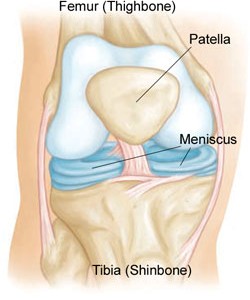
Based on some provacative testing (that’s testing to see what elicits pain not testing done by a woman in lingerie) I have a meniscus injury. I won’t know the extent unless I get an MRI but it’s not bad enough for that.
It’s no worse than it was when I did it on Monday (10/15/12) but it’s no better either.
It hurts when I stand for too long, but only in a certain range of motion (30-60 degrees). It actually feels better after I’ve been sitting with it at 90 degrees, so keeping it straight for extended periods is what I have to avoid.
This is probably because the bent position keeps the joint open and takes pressure off the meniscus, while the straight knee position closes the knee and puts pressure on it.
Here are some other things I’m doing to get back at it ASAP:
Keeping it moving by walking, biking and <shudder> the elliptical – the more blood flow the better to whisk waste products out and bring nutrients and oxygen in
Taking fish oils as per normal
Making bone broth soups at least once a week to get the same benefits as glucosamine, chondroitin, hyaluronic acid and other substances related to collagen as well as a shitload of minerals that support healthy bones and joints
Taking a natural eggshell membrane supplement (NEM) once a day (started 10/19/12)
Other than that, my normal whole food diet and doing my best to sleep a good 8 hours a night.
I might get some acupuncture going, but for now, I’ve just got to wait another week to see how my knee responds.
I’m going to continue to post blogs up here about it every once in a while for you to see what I’m doing for injury recovery and also use it as a journal for myself to track my progress.
As I said in my first blog; this is my third ‘real’ go around at the MMA Ripped program. However, this is the first time I have felt the strength and endurance at this point in the game.
I found that 45 seconds in the plyo exercises is more of a mind workout than a strength workout. It’s really gruelling to push that extra 15 seconds from 6WO. My bench press and deadlift numbers went up on my max sets, which I was very proud of. I pulled off 8 reps @ 205lbs for bench press and 7 reps @ 305lbs for deadlifts.
This was a week where I tried to stay true to my eating habits and keep it locked to my nutrition guidelines. Not that I hadn’t before, but I kept a closer eye to it this week. One thing I was able to learn thus far throughout this program is what my body likes and can handle; and what it can’t. For example, I came home from work one day at 3:45pm and decided to have a couple slices of whole wheat toast with natural peanut butter as a snack (I know, not in the nutrition guide) and almost immediately following it, my body felt tired and sludgy. It showed me that if I eat that type of carb later in the day that it will slow me down and lose energy. I have now shy’d away from them at that time and stick to it in the mornings.
That is enough rambling for this week. Keep it locked and thanks for the comments.
Speaking of injuries, I just tweaked my knee doing 3 reps at 275 lbs of Back Squats. Reps 1 and 2 were awesome, but on the 3rd rep I strained my left patellar tendon. I didn’t hear a pop or anything like that, so I should be back to normal in a week or 2 (hopefully). I used this bag of frozen organic chicken hearts as my ice pack:
Showing my knee some ‘love’ with chicken hearts…
I couldn’t find the bag of frozen edamame that I used when I hurt my hand last time, so the chicken hearts had to suffice.
Now, let’s talk shoulder friendly training.
Proper exercise technique is critical for keeping your shoulders healthy. Especially with all the punishment they take if you train MMA.
If you’ve got shoulder issues, this is what you need to fix them, but the principles below will prevent any issues from getting worse.
Principle #1 – Ensure Proper Scapular Movement
Scapular movement terminology.
Whenever you move your arms, your scapula should move proportionally.
When you do a horizontal push or pull, the scapula should slide together as your hands move towards your body and slide away from each other as your hands move away from your body.
So in a Pushup, the scapula pinch together as you lower yourself and slide away as you push up.
During a vertical push or pull, the scapula should rotate upwards as the hands go away from your body and downwards as the hands move closer towards your body.
In a Pullup, the scapula rotate downwards when you pull yourself to the bar and rotate upwards when you lower down.
One exception to this rule is when you’re lying down on a bench or floor like in a Bench Press – the scapula aren’t free to move properly, so in this case, keep them pinched together to avoid impinging the shoulder and overusing the anterior delts.
Even if you’re just lying on the floor for a Hip Extension exercise where you’re not using your arms, pinch those blades together to reinforce good posture. We need as much of this as we can get.
Principle #2 – Coordinate Breathing to Movement
Breathing is an important consideration to pain-free training as it has a big effect on alignment of your thoracic spine.
Take a second here while you’re reading this and follow along with me…
Breathe all your air out…
Now, take a slow and full deep breath in, then just let it go.
.
.
Did you notice that you got taller as you inhaled?
Inhaling helps with thoracic extension.
Most people get breathing during pushing movements correct – you breathe out when you push. Good job, keep doing it this way.
But most people screw up breathing during pulling movements – you should BREATHE IN when you PULL towards your body, so breathe in when pulling the barbell towards your belly in a Bent Over Row, and breathe in while you pull yourself to the bar in a Chinup.
Doing so helps extend your T-spine and allows the scap retractors to properly finish the movement.
If you’ve been doing it the other way (like most stock trainers recommend), start with lower weights and slower tempos to retrain this physiologically correct breathing pattern.
Principle #3 – Activate Your Lats
While the lats are often only thought of as pulling muscles for exercises like Rows and Pullups, they are an important shoulder stabilizer, keeping the head of the humerus properly seated in the shoulder joint.
One misconception is that the lats pinch your shoulder blades together – they don’t, because they’re not attached to the shoulder blades at all, as you can see in the image to the right.
To activate your lats when you’re on the ground for a Pushup, doing a Bench Press , or rowing, keep your elbows a little tighter to your sides and think of pulling the head of the humerus into the socket.
During Pullups or Pulldowns, thinking about pulling your hands apart without actually moving your hands, like you’re trying to stretch the bar, gets greater lat activation.
Add these 3 principles to your training and you won’t be damaging your shoulders when you workout.
Now, if you’ve got restricted shoulder movement, you’ll have problems performing many different upper body exercises, so if this is you, I suggest you check out the 6-Step System to Release Your Tight Shoulders here.
This week was a tough one to stick with the whole nutrition plan, as up here in Canada it was Thanksgiving. I spent the entire Thanksgiving weekend in a very small town in British Columbia called Silver Creek.
Now, onto the training portion of things. In the sixth week I feel the strength portion of things increasing like crazy, I absolutely love the ISO pushups and pullups. When it comes to the sparring sessions, I rock through them with not a heck of a lot of effort. I have a feeling that in 5WO, the extra reps are going to put me through some grueling challenges.
I don’t know if any of you can help with some tips, but during one legged side-bridges, I find my hips ache quite a bit. I have a tough time holding for any longer than 10 seconds.
I will now mention the Thanksgiving FEAST. I didn’t over indulge, however I did have quite the turkey high. I ate a little bit of mashed potatoes and had a bun. Want to know the funny thing about eating those things though, I felt very sluggish following those extra carbs.
Because of this program, I now know what foods do for my body and what I can and can not eat.
If you’re not feeling 100% for a hard training session, but you still want to do something, then you might want to think about doing an Active Recovery Workout.
But the type of workout you do depends on what you’re recovering from.
Check the latest Ask EricWongMMA video here where I discuss this topic:
To follow up on this video, one point that I want to really make clear is that building in Active Recovery Workouts is probably less beneficial than learning when your body needs one.
Like I said in the video above, the symptoms include:
1) You don’t have that high end ‘pop’ type of energy – Central Fatigue
For #1, you can train your whole body, just don’t train too intensely.
For #2, it’s very local, so say your chest is sore, you can still train your legs hard, but you may want to throw in some light movements for the chest to increase blood flow to the muscles to speed their recovery. It’s also a good idea to stretch the chest so the muscles don’t shorten.








 Protein synthesis is the term used to describe when your body is building muscle – synthesizing (creating) protein.





 Principle #3