Today, I’m sitting at my desk, water bottle to my left, in horrible posture, 5 empty envelopes to my right just waiting for money for some guy who’s getting a whole lotta dough just for having a really nice effin’ camera.
If you’ve gotten married in the past 5 years, you know what I’m talkin’ bout. 😛
As I’m writing this to you, I’m asking myself this question:
“Right now, with all I’ve learned, what can I create that will help my INSIDERS the most?”
But I’m not in a rush to answer it…
I’m going to let my mind bring the best answers forward for me to choose from.
“Hey, I just want some new exercises, shut up already!”
Sorry, can’t do that Johnny, this is the stuff that’s at the CORE of all success, all top performances and achieving the highest level of fitness your body is capable of.
OK so we got 100+ Comments on Part I of the MMA Altitude Training Device Review, which tells me you guys have seen the ads and heard the hype and really want to know…
Are Altitude Training Devices Worth It?
To recap, this is where we left off last time:
“There are no studies on MMA specifically, so I had to search LONG and HARD to find something that would at least come close.
This took me FOREVER, because most of these altitude studies are done on endurance sport athlete such as runners, cyclists and cross-country skiers.
But lo and behold, I stumbled upon one, a moment before my eyes were about to explode from reading these cryptic journal articles all day. Scientists reading this – why can’t you write in normal English!”
Lately, I’ve gotten a number of questions about various devices that you put in your mouth or wear over your mouth and/or nose that purport to simulate altitude training my fighters, customers and subscribers.
You might’ve seen people using various devices on YouTube or other places.
When I get multiple questions about something, I know it’s time to roll up my sleeves, pull out my library card and do some down and dirty research.
If you don’t know what I’m talking about, they basically restrict your breathing, which is supposed to simulate training at altitude.
Various claims are made about these devices, such as:
Increased lung capacity
Improvements to something called your Anaerobic Threshold
More energy
Improvements in physical and mental endurance and mental focus… and many more.
WARNING: we’re going to get a little technical here, so if you have absolutely no desire to talk science with me, then skip to the Conclusion at the bottom of this article for the answer to the question, “Will using these devices improve my performance?”
Otherwise, into the rabbit hole we go…
The first question you should be asking here is…
“What is Altitude Training and How Might it be Beneficial for MMA?”
To understand the science behind altitude (elevation) training, you must understand the following definitions; otherwise you’ll be lost at sea without a paddle.
Anaerobic/Lactate Threshold
The intensity of exercise at which your body begins to accumulate lactic acid*; at this point, energy production shifts from aerobic (unlimited energy) to anaerobic energy production (very limited)
*NOTE: this is not entirely correct but I’m not going to waste time here explaining what lactic acid is and what really causes fatigue, the main concept is still the same, so if you’re a science geek getting ready to call me out, don’t bother, it won’t help you, me or anyone else reading this
VO2 Max
The max amount of oxygen your body can make use of for fuel; often used in studies as a test for aerobic fitness, although it’s not often the best indicator of actual sport performance; often expressed as either 50 ml O2/kg bodyweight/min, or 5 L O2/min, either way, HIGHER is BETTER
Hypoxia
When the air you breathe contains less oxygen than normal
Air
The stuff you breathe did you really have to click this one? lol; composed of about 78% nitrogen (N2) and 21% oxygen (O2) at every altitude
Altitude
Refers to elevation above sea level where the air is less dense, and thus contains less oxygen because there are fewer particles in the air overall; % of oxygen remains the same as at sea level; two major variables are manipulated, where you train (High or Low) and where you train (High or Low), thus, the following combinations exist and have been thoroughly studied:
Train High Live High (THLH)
Train Low Live High (TLLH)
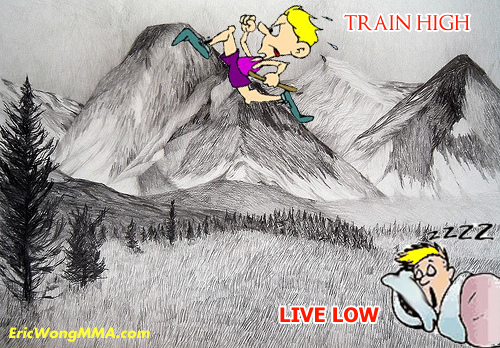
Train High Live Low (THLL)
Train Low Live Low (TLLL – what most of us do all the time)
Some popular altitudes:
Boulder, Colorado, USA: 1650 m
Whistler, British Columbia, Canada: 652 m
French Alps: 2500 m
If you want to see how exactly how dense air is at a certain altitude, check this link out:
Now that you’ve got the basics let’s talk altitude training…
Altitude training is based on the premise that when you’re at altitude, there’s less oxygen in the air, making exercise a lot harder. The higher you go, the less oxygen there is, the harder exercise is.
Because of this, it’s theorized that altitude will force your body to adapt increase your red blood cell (RBC) count and thus improving aerobic performance, delaying onset of anaerobic energy production and improving recovery.
The bottom line is that…
More Red Blood Cells = More Oxygen (to feed your working muscles with)
This is important – remember it, you’ll need this knowledge later.
This is the theory, anyway, but lucky for us, it’s been rigorously tested by scientists from around the world.
Some cool sports science history – altitude training gained huge popularity after the Olympic Games in 1968 which were held in Mexico City1.
Mexico City is at an altitude of 2300 m, so for those athletes who weren’t prepared for this, it was a huge shock and the exercise physiologists were put to work to figure out how to use this to their advantage.
Now, as mentioned in the Altitude definition above, there are 3 main combinations of altitude training that have been studied: Live High Train High, Live Low Train High and Live High Train Low.
With respect to these devices, if it’s supposed to mimic training at altitude and you wear it during your workouts, this would be similar as Live Low Train High (LLTH), since during your workout, you’re ‘training’ at altitude and the rest of the time you’re at your normal altitude.
So we’re going to focus on the studies that test LLTH and forget about the rest.
[For now, maybe if you’re really interested, I’ll discuss the others a future post. Let me know in the Comments if this is something you’d be interested in reading]
“… A common feature of virtually all studies on “live low–train high” is that hypoxic exposure only during exercise sessions is not sufficient to induce changes in hematologic parameters. Hematocrit and hemoglobin concentrations usually remain unchanged with “live low–train high.”
“What does this mean for YOU as a Mixed Martial
ArtistLooking for Peak Performance?“
So, do these devices actually increase red blood cell production and improve oxygen delivery to your working muscles as claimed?
When Vogt and Hoppeler talk about “hematocrit” and “hemoglobin”, they’re basically talking about RBCs. For your purposes, hematocrit = hemoglobin = RBCs. For each, more is better.
If you don’t know what RBCs, hematocrit or hemoglobin are, here are some definitions:
Cells in your body that are responsible for transporting oxygen where required; the more red blood cells (RBCs) you have, the more oxygen you can transport to working muscles
Hematocrit
Refers to the % of total blood that is made up of RBCs; more is better (to a point, if your blood gets too ‘thick’ you could die but this will never happen through training, only drugs)
Hemoglobin
The specific component of a RBC that carries the oxygen.
Let’s do an analogy – it’s kind of like if you were carrying a backpack that had your boxing gloves in them, you are the RBC and yes, you’re carrying your boxing gloves, but to be more precise, your backpack is actually carrying your gloves…
Well, your backpack is like Hemoglobin. Get it?
If not, I don’t blame you, the analogy sucked. Leave me alone – it’s late.[/features_box_azure_blue]
So Vogt and Hoppeler state that LLTH (altitude training) does NOT improve red blood cell paramaters, which means that performance does not improve either. But let’s look at some hard data, just to make sure, OK?
There are no studies on MMA specifically, so I had to search LONG and HARD to find something that would at least come close.
This took me FOREVER, because most of these altitude studies are done on endurance sport athlete such as runners, cyclists and cross-country skiers.
But lo and behold, I stumbled upon one, a moment before my eyes were about to explode from reading these cryptic journal articles all day. Scientists reading this – why can’t you write in normal English!
How I looked and felt slaving through journal articles on my computer.
AND this is where we have today’s cliffhanger… 😛
I put a lot of work into this article, as you can tell from this first half…
So if you want the Conclusion, I want to see 100 Comments letting me know that you want to see it, otherwise, into the vault it goes!
I’m 100% serious – if we don’t get at least 100 Comments, you won’t see Part II.
– Eric
P.S. I give you the straight goods about the various altitude simulation devices, so if you want to know if it will improve your performance or not plus some extra data I uncovered from an unlikely source, leave a Comment below:
Today’s MMA workout video is in celebration of the first weekend of July holidays…
This past weekend us Canadians celebrated Canada Day while our neighbours to the south celebrated Independence Day.
Basically that means a lot of fireworks and beer.
I was lucky to be able to hit up the cottage again (2 weekends in a row!) and had a great time.
I brought my trusty 24kg Kettlebell and TRX with me to get some workouts in while I was away and workouts I did!
Unfortunately, the deer flies were out in full force and were attacking me despite being drenched in Citronella, which, as I’ve discovered, has zero effect on deer flies.
Who knew?
Oh well, at least I smelled lemon-y fresh during my workout!
The two exercises I’m going to show you in today’s video are good for 3 things:
Increasing PUNCHING POWER via rotational hip power and core stability
Decreasing SHOULDER INJURIES via compensatory strengthening to balance the demands of MMA training
Increasing GRIP STRENGTH
Not too shabby eh?
Plus, all you need is a Kettlebell and TRX.
NOTE: I like to have fun with my videos. If you want some serious, stuffy dude who likes to talk over your head, go elsewhere. Otherwise, enjoy and most importantly, put it to use. Check it:
Here are a few more details about each exercise:
The “Electron”
This exercise is great because you work the KB through a circular range of motion, which is fantastic for the shoulders and develops hip power and core stability in the rotational (transverse) plane of motion.
Enter 3D training with this exercise! It can be done for reps (10 per), time (60 sec or any other method you want to use.
The “Scarecrow”
This TRX exercise will balance the demands on your body if you train MMA by training your upper back muscles and posture, helping you decrease injuries.
Go for higher reps here, 10-20 is a good number to shoot for, so you can focus on perfect form and develop strength-endurance and maybe even a little upper back muscle mass.
So…
Whaddya think of the exercises?
Most importantly, what’d you think of the fish? 🙂
If you have no questions or Comments, simply introduce yourself and tell me where you’re from.
It’s cool to see the different parts of the world where people are visiting my blog from.
I love getting emails from guys who use my programs and this one was especially cool because he had some #’s to report on top of how he felt…
Check it out here:
“Eric,
I’ve had great results from going through your system. This past week I did an old workout I used to do with some of my power lifting buddies, and all of my maxes are up at least 10% which I totally didn’t expect only lifting twice a week at times. And my endurance is so much better than it was before. I still may not be able to beat my sensei just yet but I can grapple, spar, and keep up with him endurance wise no problem.
And your nutritionitsu guide is awesome. Hell, from cooking all my meals at home I can eat ten times better than I ever could eating out all the time. Not to mention it saves me money which is always a good thing being a college student.
To sum it up your program greatly exceeded my expectations and I’m definitely planning on getting your advanced MMA power program and looking forward to seeing how much more my strength, power, endurance, explosiveness, and everything else will increase even further.
Bryce Allenbrand”
Way to go Bryce!
Here’s the program Bryce used to get stronger while working out LESS:
Like I always say, it’s all about working hard AND smart.
Today’s society is taking a MASSIVE toll on our bodies…
Many of us park our butts in an office chair for 8 hours a day mulling over spreadsheets or plugging away inside Outlook…
Others are road warriors who spend a couple of hours traversing the land in the modern-day horse and buggy called the car.
Not to mention our hobbies, one of which, if you’re reading this blog, is likely mixed martial arts training, with its guard, clinch, single and double leg takedown attempts, chin-tucked fighting stances, shoulders rounded forward like a turtle’s shell, abs constantly on to make the body as small a target as possible.
I know it's not MMA, but it's a perfect example of what I'm sayin'…
Our bodies, which are almost a thing of perfection – the strength, power, athleticism, quickness and grace with which we move in the upright position and with good posture is something truly amazing – are regressing and de-volving to the point that Darwin would be afraid for our species’ (modern man) survival.
In today’s post, I’m going to show you how to PROPERLY perform bodyweight squats, plus 2 new squat variations to try.
But before we get into that, I want to talk about something important…
I teach a lot of exercises and how to perform them correctly on this blog, but first and foremost, I am a STUDENT OF THE GAME.
I may be more experienced than you (or maybe not, there are a lot of great trainers and coaches that visit here) when it comes to S&C, but one thing I’ll never, ever do is consider myself a ‘master’.
I believe that once you consider yourself to be a ‘master’ at something, it’s easy for you to think you know it all and stop learning and growing.
With the weather this gorgeous, I have to do more videos outside like this one on sprint training technique…
I mean, I’m the boss, I might as well enjoy the weather, don’t ya think? 🙂
So anyway, check out this video and then the description below where I summarize the key technique tips to effective sprint training. If you like it, do me a favour and email it to your athletic friends, trainers, or anyone who enjoys improving their physical fitness.
SPRINT TRAINING TECHNIQUE SUMMARY
There are 4 keys to effective and powerful sprint training technique. Let’s start at the top and work our way down.
Sprint Training Technique Point #1 – Posture
Forward lean during acceleration
Stay tall in good posture, chin tucked at max speed
DON’T: slouch, lean back
Sprint Training Technique Point #2 – Arms/Shoulders
Hands relaxed
Movement at the shoulders
Elbow can extend/flex slightly
DON’T: hunch shoulders, clench fists, straighten elbows, run like a fairy
Sprint Training Technique Point #3 – Leg swing (recovery leg)
Butt to heel when pulling leg through, and…
Pull the knee up with the hip flexors
DON’T: pull the leg straight through
Sprint Training Technique Point #4 – Foot strike
Whole foot can land or land more on the forefoot
Eliminate/minimize braking action – foot lands as it is already traveling backwards (negative foot speed)
DON’T: land too far ahead, heel strike
Those are the 4 keys to effective and powerful sprint training technique. Implement them into your workouts and you’ll develop a more powerful and integrated body that’s able to better transmit forces from the ground up through your core.
Leave any questions and/or comments you have about sprint training below.
To followup last post where I shared the Towel Bicep Curl exercise, I’ve got another great exercise to use to add elbow-popping submission power AND the stamina to last that I invented called the Good Morning Curl.
But before we get to that, last post I posed the question, “Why do you think I named my new program Python Power?”
The most powerful submission artist on the planet…
Most of the answers described the obvious link of how the python powerfully constricts and suffocates it’s victims to death…
Many of you also told me how once a Python gets its grips on its prey, the prey will never escape…
In my last post I shared a video that I dubbed my “Lowlights” video…
I asked you to guess why I named it such and Jay_G got it right with his Comment:
Because Jay_G watched the video and left his Comment, he’s going to win the new Python Power Program that I’m releasing on May 30. [Congratulations Jay_G! I’ve got your email and I’ll be in touch when the program is live with your D/L link]
That just goes to show that it pays to read the articles, watch the videos and COMMENT.
Maybe next time you’ll win something cool, but you won’t win anything if you don’t participate. You might even get that chance right now in this article… Read the whole thing to be sure… 🙂
Now you may be curious as to what this Python Power Program is all about…



 Unfortunately, the deer flies were out in full force and were attacking me despite being drenched in Citronella, which, as I’ve discovered, has zero effect on deer flies.
 Many of us park our butts in an office chair for 8 hours a day mulling over spreadsheets or plugging away inside Outlook…


