Tag: hip flexibility

  • Get a DEEPER Squat With This Drill

    Get a DEEPER Squat With This Drill

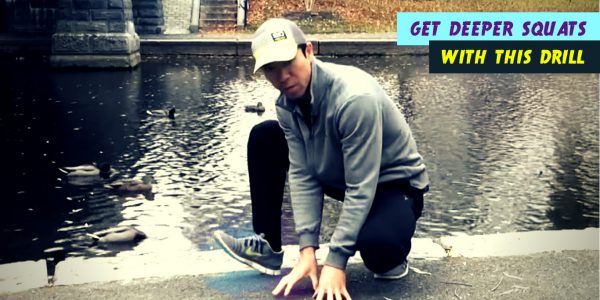
    Today’s video is going to improve your squat mobility.

    Yes, I can make such a bold claim, regardless of what you’ve done before, because I know the drill we’re going to go through includes elements I’ve never seen anyone else use to improve their squat range.

    Before we get to it, one element I’d like to highlight is how it’ll help you gain ankle dorsiflexion (pulling toes up towards knee), a common factor when limited that makes people feel like they’re going to fall backwards when in the deep squat.

    It’s not the only factor that contributes to this, but it’s definitely a common one.

    If you run or jump a lot or do any other high impact movements on your feet, your ankles take a beating.

    Over time, dorsiflexion deteriorates and because it’s not something most people (well, not peeps like you and me) think of training, it gets worse and worse where it can ultimately result in a compensatory movement and injury.

    The thing is, the injury will often occur elsewhere, such as at the knee or hip.

    But because the root cause is limited ankle range, it’s never addressed and you might go on for years and years hurting yourself and treating symptoms while feeling frustrated and hopeless not being able to do what you want to do.

    That’s why keeping tabs on things like ankle dorsiflexion is important and this drill will help you not only keep tabs on it, but MAXIMIZE it so it never causes an issue.

    That’s just ONE of the benefits of this drill and it’s why it’s a new staple in my warmup.

    So let’s get to it, shall we?

    Follow-along then let me know how it felt in the Comments when you’re done.

    By the way, the approach used in this drill is just one reason why my Hip Flexibility Solution has proven so effective.

    Click here for the complete scoop on the Hip Flexibility Solution.

  • Exercise to Fix Posture and Open Your Hips

    Exercise to Fix Posture and Open Your Hips

    It’s summer here in Toronto so I’ve been riding most everywhere.

    I love riding in the city.

    However, if we ever come across each other and you’re driving, I apologize, because I ride a bit like a maniac – dodging cars, running lights, squeezing through tight spaces, etc…

    Nothing dangerous as I’m in full control and completely aware of what’s going on in front, beside and behind me, but if you’re not used to riders like me, you might be shocked.

    For some reason I feel compelled to get to my destination as fast as possible.

    Helps with the cardio.

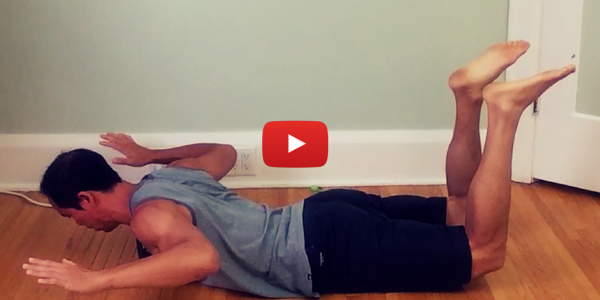
    Anyway, the exercise I’m sharing with you today I call the Skydiver and it’s great for people who ride to counteract the physical demands of rounded shoulders and flexed hips, as well for general posture, people who sit a lot, balancing the fight stance, etc.

    skydiving

    The one and only time I’ve been skydiving was for my friend’s bachelor party – it was pretty damn scary and cool at the same time.

    The best part about it for me was pulling the chute right when we got into the clouds as everything went quiet, all I could see was white and for an instant I felt like I was floating in heaven.

    The reason why I call this exercise the Skydiver is because this is the position you need to hold when free-falling so you don’t get twisted and can safely open your chute.

    NOTE: I call you “Kyoudai” at the start of this video because that’s what I call my Inner Circle members, which loosely translated means “brother” or “sister”. This video was originally for my Inner Circle members only but I thought I’d share it with you too.

    TIGHT HIPS? | TIGHT SHOULDERS?

    Do this daily and work up to 4 x 30 second holds for a total of 2 minutes, starting from 6 x 10 sec holds for a total of 1 minute.

    And if you don’t mind, please share the love, I’d really appreciate it!

  • Hip + Shoulder Flexibility FLOW Drill

    Hip + Shoulder Flexibility FLOW Drill

    This drill requires flexibility, coordination, balance and strength – so it hits many different Biomotor Abilities.

    It also trains the Push, Twist and Lunge movement patterns in multiple planes of motion, making it one bad ass exercise.

    Give it a shot:

    The Cossack portion of this drill definitely requires good adductor flexibility and strength.

    If you haven’t yet gotten the 3 Freaky Flexibility Techniques PDF, definitely grab it below because one of the exercises will help your Cossack tremendously if you have problems with it.

    [thrive_2step id=’20388′]hip-flexibility-exercises

    [/thrive_2step]

  • On COURAGE, Cramping, Hip Flexibility & Shoulder Impingement

    On COURAGE, Cramping, Hip Flexibility & Shoulder Impingement

    I was browsing through the folder my assistant Madalina keeps for me with all the questions I get from practitioners around the world and I’ll be answering a few about shoulder impingement and some hip flexibility stuff related to my recent “front splits” video.

    Before we get to that though, I want to share about a phenomenon I’ve been noticing lately…

    Since I made the decision to be very open with you, and shared about the deaths in my family and how I’ve been dealing with it all, I’ve noticed more of my powerDOJO “Inner Circle” members opening up as well.

    Recently, a couple of my long-standing Kyoudai (“brother/sister” in Japanese – how we refer to each in the Inner Circle) have shared their personal struggles, how it’s been affecting them and their thoughts going through it.

    Even though we connect virtually in a private “Mastermind”, being open and authentic isn’t easy.

    But it’s much easier than doing so in person, especially with the support and advice that come from the “Mastermind” because we are all 100% supportive, positive and hold each other’s best interests at heart.

    For example, one member shared about how he feels like a “failure” for what’s gone on in his life over the past 2 years, having had no real purpose or “code”, being inconsistent with his training and not living the life he wants.

    The thread was titled “My Confession” and it took
    MAJOR COURAGE to share what he did.

    Courage comes from doing what isn’t comfortable.

    What might seem scary.

    Going into a fight that you know you’re going to win doesn’t take courage.

    His opening up and sharing authentically in a way that especially men are not taught to do or might even be looked down upon for doing elicited a level of support and community that I was very humbled and proud to see.

    Having support like this in your life is important and if you’re surrounded by supportive people, then awesome, keep that network strong.

    But if you need a place where you can feel comfortable opening up, sharing your struggles and finally letting go of the garbage that’s been holding you back, let me know and we’ll see if you’re a fit for the Inner Circle.

    ============ FRIDAY Q&A =============

    Q: I got an email from Scott M. about shoulder impingement:

    “I have right should problems and sometime get an Anterior impingement . I’ve noticed that when lay down , the right Shoulder joint is about 2 inches off the floor ?”

    A: This is a common problem and typically, this is a sign of extreme pec minor tightness.

    The pec minor pulls the scapula forward and this can contribute to rounded shoulders and winged scapula.

    The mistake people make is that they try to address the tight pec minor only, but the key is to do this as well as simultaneously building strength in both the pec minor and the opposing and supporting muscle groups in that area to fully reprogram the central nervous system.

    With only stretching, this reprogramming doesn’t occur and the tightness will always return.

    I explain more HERE and HERE.

    Q: Here’s a question from Phil in regards to the Active Groiners exercise I sent you last week.

    “Is this still a useful exercise to do if I’m not able to “hover” my front foot? Indeed, I can’t even lift it off the ground. I can engage the glute on the leg that’s extended backward, but cannot raise the front foot.”

    A: For this scenario, the simple solution is to start with your hands elevated, so you can place your hands on a bench, then when you can do it from there, go lower and lower and lower and progress until you can do it with your hands on the floor.

    Whenever you encounter an exercise that you can’t do, think how you can scale it back.

    Use your creativity – with exercise, there is no right way to do things, just remember the fundamental principles:

    Maintain good posture
    Breathe
    Control your movements
    Don’t do anything stupid

    Heck, that’s a nice simple life philosophy right there.

    Maybe I should do an infomercial on it.

    Let’s answer one more, ok?

    Q: Finally, let’s address CRAMPING – here’s a Q from Jay T.:

    “Just stared the SFS about a week ago. And for the first time in a long time, I was able to make it through a Crossfit workout with VERY LITTLE shoulder pain! Amazing
    But, while doing the routines outlined in your program, I have been experiencing some scapular tightness on my left shoulder, along with some cramping.
    Is this just part of the process, especially with years of damaging my shoulders? I have been careful in terms of not over doing the exercises, as you recommended. “

    A: AWESOME.

    To answer your question – when you start to build strength at end ranges of motion through the exercises I show in the Shoulder Flexibility Solution, cramping can happen.

    This is because the muscles simply aren’t used to contracting in these ranges.

    But this is the only way to build your functional range of motion and after 1-3 weeks, it will likely disappear, so just keep at it and if a bad cramp happens, STRETCH the muscle passively or dig into it with your thumb or a ball to relieve the cramp.
  • Improve Front Splits Flexibility AND Strength

    Improve Front Splits Flexibility AND Strength

    We’re gonna get to the exercise in a sec but first, I have to share something I’ve been feeling with you…

    I’ve been inspired at the movement that’s taking place in the world of fitness because I feel like we’re finally getting away from the superficial as the ultimate goal.

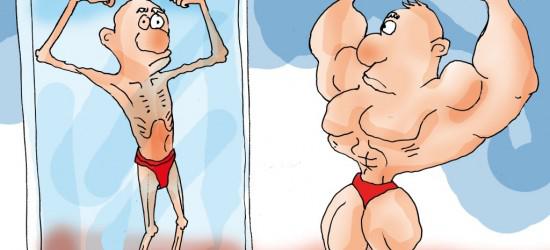
    While avoiding obesity and being lean and muscular is definitely important and a reflection of healthy choices, for the longest time, these ideals dominated fitness to the point where anorexia and megarexia are common occurrences in today’s society.

    megarexia-anorexia

    Well this is all changing, my friend, and in my not so humble opinion it’s about damn time.

    Since Day 1, I’ve been more interested in how we move and perform than how we look and I’ve also been teaching how the continued elevation of your ability to move, whether it’s through flexibility, mobility, strength, speed, power, endurance or what have you will ultimately give you a body that looks as good as it performs, as long as you follow just a few key nutrition principles.

    When bodybuilding and aerobics were the main forms of exercise, once the physique was attained, there were only 2 choices an individual had:

    1. Continue to push the envelope with respect to physique, towards anorexia or megarexia.
    2. Stop your evolution and just maintain doing the same old, same old, which typically results in boredom and alternating between having your ideal physique and having to work towards your ideal physique.

    But the irony is that when physique becomes secondary to performance and movement ability, it actually becomes easier to maintain.

    The reason why is two-fold, one, because continually elevating your fitness will force your body to continually adapt in ways that are beneficial to aesthetics and two, because with respect to performance, the sky really is the limit and there’s no way you’re going to be elite in every BMA.

    That’s why it’s so fun – because there’s always a new challenge.

    If you’re not interested in being challenged you’re basically saying you want the easy way out.

    But since you’re here on powerDOJO.com, I know you’re not the type to look for the quick fix – you realize that work is required and you’re more than willing to put it in.

    Now, if your goal is just to be fit and healthy…

    The key is to be a GENERALIST vs. a SPECIALIST.

    A generalist works towards building:

    • Flexibility and Mobility
    • Strength and Power
    • Speed and Agility
    • Conditioning and Cardio
    • Balance and Coordination

    In short – all of the Biomotor Abilities (BMA).

    So if your goal is to specialize, for example, you want to be an elite Powerlifter, you have to focus on the Strength BMA at the expense of the others.

    If you’re fine with that then cool, rock on!

    The specialists are those who show the generalists what’s possible.

    But for you and I, when the goal is to be able to enjoy everything in life that’s available and be someone who is fit and healthy, being a fitness generalist is where it’s at.

    I believe this is why my approach to fitness, which evolved from training mixed martial artists, who must truly be generalists in their combat training as well as their fitness, resonates with so many including those who don’t train the martial arts at all.

    Because now, we no longer have to focus on the superficial and instead, can work on what we’re capable of instead of just how we look.

    FUCK. YEAH.

    /END RANT

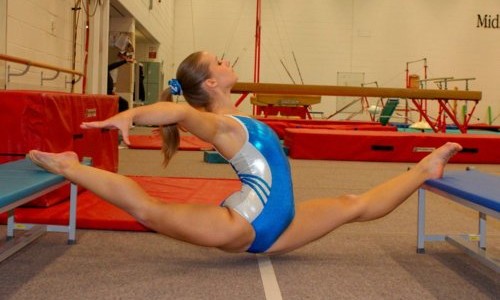
    On that note, here’s today’s exercise, which will not only improve your flexibility and mobility, but also your strength, specifically in the front split position.

    Give it a shot and let me know how it feels in the Comments below.

    [thrive_2step id=’20388′]hip-flexibility-exercises

    [/thrive_2step]


  • The Evolution of Flexibility

    The Evolution of Flexibility

    If you’re one of my top practitioners, you know I’ve been sending out a lot of content on flexibility and mobility (which I’ll just use the term flexibility for going forward) lately.

    This is because I spent many years talking more about building Strength, Power and Conditioning and since integrating and taking flexibility training more seriously for myself and my athletes, I’ve been getting better results in while actually doing less in these other areas.

    The reason why is because flexibility is a Biomotor Ability that most people neglect until it’s too late…

    You know, like when it’s tough to put your socks on, or when your posture makes you look more like the Homo neanderthalensis species instead of Homo sapiens…

    And then, when you add proper flexibility training in, you make
    MASSIVE progress in a short amount of time because
    it’s like discovering an untapped gold mine.

    This is what it was like for me when I first got serious about flexibility.

    Before, when I threw a kick it was like my hips were tearing apart and I could barely make it to stomach level.

    Now, when I throw a kick, I can turn and put my hips into it whether it’s to the legs, torso or head.

    Plus, how this training has literally affected every other Biomotor Ability like Strength, Power and Endurance, since now, my body is no longer fighting itself and my joints move loose and free while my muscles are allowed to work unhindered.

    [thrive_2step id=’20388′]hip-flexibility-exercises

    [/thrive_2step]

    .

    The feeling can be summed up nicely with just one word:

    FREEDOM

    But like everything, there are different ways you can go about your flexibility business and the most effective depends on where you’re at.

    Like everything, as you get deeper into your training, the techniques you use must evolve, otherwise, you’ll get stuck.

    It’s fine to get stuck if that’s what you want, but if you’re here and you’re down with the powerDOJO Way, then evolution is your thing and you want to keep learning and applying and improving day in, day out.

    And I LOVE that about you, which is why I love putting out content like today’s video, which might be an exercise you’ve done before, but when you do it the way I describe in the video, it’ll feel a heck of a lot different and give you much different results.

    First, watch the video, then I’ll talk a bit more about why this type of exercise is an EVOLUTION in your flexibility game:

    https://vimeo.com/151092710

    Have you done the Groiner exercise before?

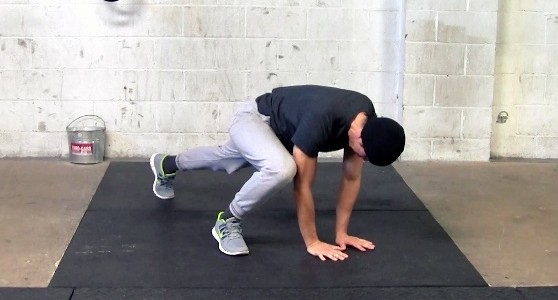
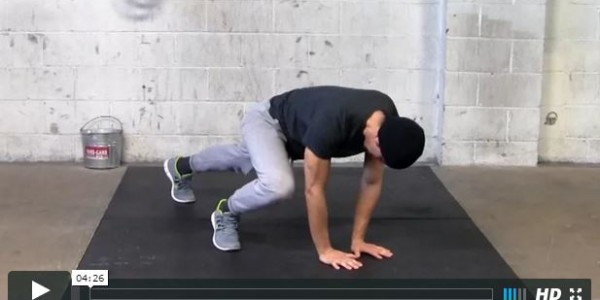
    It’s kinda like a Mountain Climber, except your knees go outside your hands instead of inside.

    And it’s typically done in a jumping-like fashion, where you bring your leg up and rapidly jump your legs up and back.

    Sometimes it’s done where you jump the leg up and then sit deeper into the stretch before switching.

    Either way, it’s different than what I show in the video.

    The key difference is by bringing your leg up in a controlled fashion and holding it in the top position actively, versus jumping the leg up, which brings the leg up to a point that can only be reached through momentum, then sitting statically into the stretch.

    The results you’ll get from this different approach that you won’t get through the traditional approach include:

    • Building hip flexor strength through the full range of hip flexion
    • Training your core to stabilize while working through hip flexion (very important for those with low back pain)
    • Not only that, but training your core in a diagonal pattern, which is more applicable to sport and daily life (think walking, running, swinging a club or bat, pushing things)
    • Strengthening of the glute of the extended leg, which also lengthens the hip flexor of that leg

    So I’m not saying the typical Groiner is bad, just that we can upgrade it if our goal is to improve upon our flexibility.

    The thing is, this exercise takes more strength, more concentration, more discipline to execute properly.

    While it looks simple, there are many subtle pointers that contribute to its effectiveness.

    If you’ve tried it already and followed along with me, you know what I mean.

    But I know you’re down with the idea that if you’re going to do something, you might as well do it right, and it’ll take time to master this one simple move and it’s time you’re willing to invest.

    That’s why I’m glad you’re here with me in this “Evolution of Flexibility”.

    Lots more to come. 🙂

    PEACE~

    Coach E

    P.S. One favour, I’d really appreciate you sharing this on Facebook (or wherever) with your friends. I’m sure they’ll appreciate being enlightened with this new info and even with a simple act of sharing that’ll take a few secs, you’ll be influencing those you care about for the better and if nothing else, it’ll grow your Karma bank.

  • Standing Band Hip Extensions

    Standing Band Hip Extensions

    This exercise helps you build a solid and clean hip hinge pattern and helps to get your glutes active throughout.

    Glutes that don’t work during Deadlifts and Squats is a common issue, so if this is something you have problems with, or if you just want to ensure you’re engaging the most important muscle group for these movements, try this exercise out.

    Do this as part of your warmup, or right before Squats or Deadlifts to activate your glutes.

    One thing that will limit your ability to activate your glutes is tight hip flexors.

    Tight hip flexors cause reciprocal inhibition of the glutes, which basically means that it’s harder to fire your glutes until you release them.

    If you have this issue, you need to fix it, otherwise you’ll suffer from under-active glutes and all of the problems associated including knee pain, low back pain and decreased strength.

    Here are 2 options to help you out:

    1) The Hip Flexibility Solution

    This is my comprehensive program to unlock your tight hips and it addresses hip flexors, hamstrings, quads, adductors and core stability via the 3D Flexibility System.

    I’ve setup a limited-time discount for you on the page here.

    2) Hip Flexor Specific Program

    This is a program created by my friend Rick Kaselj that specifically addresses your hip flexors, so if this is your only flexibility issue, grab this program to take care of it.

  • How to Improve Your Butterfly Stretch [ASK ERIC]

    How to Improve Your Butterfly Stretch [ASK ERIC]

    The Butterfly Stretch is a common stretch done by martial artists, runners and anyone who has ever been in a high school gym class.

    However, it’s a better assessment of your hip flexibility than technique to improve it.

    In this episode of Ask Eric, I show you different techniques to help you improve your butterfly stretch:

    Got a question you’d like me to answer?

    Submit your question HERE.

  • WRIST Straps | SI Joint Issues [ASK ERIC]

    WRIST Straps | SI Joint Issues [ASK ERIC]

    In today’s QnA video, I answer the following questions:

    Hello Eric, I just started your program a week ago and it is awesome. Thank You.

    I just wanted to ask, what are your thoughts on using wrist straps?

    Heavier weights but weaker grip strength. What are your thoughts on which is more important?

    Eric Baker, Omaha, USA [00:37]

    ===============

    Hi Eric, I had been suffering from SI Joint dysfunction for the last year or so…joint seems to be staying in place now, but my lower back is still tight a lot.

    If I lay on my front in be it tightens up pretty quickly. When I sneeze I have to dip my knees or if I’m sitting and sneeze one of my abs (someone every time) spasms…

    Also deadlifting is pretty much a no go as it aggravates the tightness…any ideas?

    My mate has your hip flexibility guide and was showing me a few stretches , is there anything you recommend that I sole focus on ?

    Dan Gallagher [03:04]


    If you’ve got a question about training for MMA or martial arts, nutrition, injuries or anything else that you’d like me to answer in a future QnA video, submit it here.

  • Try this exercise to improve your BALANCE

    Try this exercise to improve your BALANCE

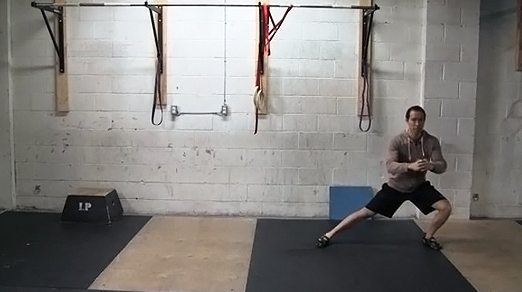
    The video I’m sharing with you today includes a couple of variations of the Lateral Lunge exercise, which you likely know.

    These variations will both improve your balance with the second variation a simple technique that you can use with any exercise to improve balance, proprioception and kinesthetic awareness.

    Those last 2 words may be foreign so here’s what they mean:

    Proprioception: how your brain knows the position your body is in

    Kinesthetic Awareness: how your brain knows where your body is in space

    Please let me know what you think after you give it a whirl.