The conventional exercises most people use to train their abs suck.
What I’m talking more about is how they do the exercises, typically with tons of reps of shitty little crunches or bicycle abs or something, or super long holds of planks.
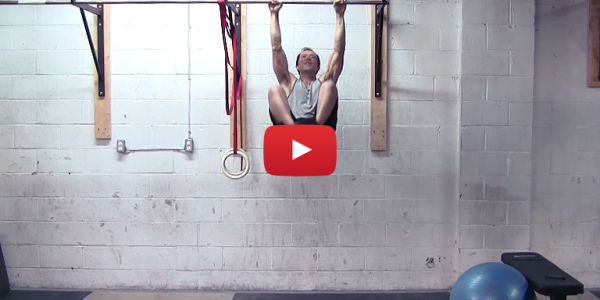
What’s more effective is stringing different exercises that require different qualities, such as training in different planes of motion, hitting different aspects of your abs and in different positions, like lying prone or supine or hanging from a bar.
This is how I train my pro and UFC fighters so I’m guessing it’ll work for you too.
Best of all – in today’s video I’m hooking you up with a nasty little circuit that will absolutely torch your core that includes ALL of these elements.
I suggest starting off at 2 rounds, then progressing up slowly to 4 or 5 rounds, then moving on to something else.
Your core adapts very quickly so it responds better to variety compared to other muscle groups, which are a lot dumber and respond better to repeated stimuli.
Check the workout then if you want some more killer core exercises and routines that don’t suck, peep the link under the vid because you want to keep throwing new routines at your abs for best results.
Like I said, VARIETY is key because your core is a neuromuscularly intelligent muscle group.
The reason why is because it is designed to protect vital areas of your body (spine, organs) and is used in pretty much every movement you do, so it has learned HOW TO LEARN very well!
These routines on the page above were designed by my pal and fellow Torontonian Andrew, who is a 2-time Ontario Gold Medalist in Boxing and Muay Thai Champ.
I highly suggest you peep it to ensure you’ve got everything you need to win the war on your core!
After a few hours in a row of sitting, do you feel really stiff and does it take a while for you to get moving and not feel like an old grandpa again?
Unfortunately, if you’re like me and you sit too much (damn computers), I bet you feel it in the one place we need mobility the – your HIPS.
When you sit, you do 2 absolutely horrible things for your mobility:
1) Shorten and tighten your hip flexors
2) Shut off and weaken your glutes
While these are 2 of the worst issues that arise from excessive sitting, there are many more, which has resulted in our medical authorities to claim that…
“Sitting is the newsmoking!”
Now, let’s not even talk about all of the athletic feats we could perform with loose, oily hips…
… since being tight from sitting too much WILL lead to things like low back pain, poor posture and the resulting shoulder and neck issues, so you’ll never get the chance to perform at your potential.
I’ve recently started doing a simple lunge combo every 30 minutes (I set a timer to remind me) that takes me 2 minutes to do that’s totally prevented that initial stiffness you get after sitting for too long.
You can do it at the office or wherever you find yourself sitting to help prevent that initial stiffness. I’ll shoot that video for you and send it to you in a day or 2.
The other day I walked into the new big-box gym that I’ve been working out at and witnessed a ghastly sight…
A 30-something guy who looked to be in reasonable shape but was probably a fat loss client was working with one of the Stock Trainers at the gym. You know, the beefy guy who makes workouts up as he goes and who’s only jobs are to count your reps, provide an occasional motivational quote (“ALL YOU”) and maybe a spot or two.
Anyway these guys were chatting and then started doing something more ridiculous than Chael Sonnen calling himself the champ and carrying around a replica UFC belt.
Now picture this: the Stock Trainer instructed his client to get up on a BOSU ball (uh oh), handed him a set of dumbbells (come on) and made him do a simulataneous squat and side raise (please god stop the madness)!
Why? Why!?! WHY!!!!
What the hell are you trying to do with this exercise?
Let me play devil’s advocate for a second and consider the possibilities:
POSSIBLE REASONING #1: increase fat burning by increasing the metabolic load due to the combination of 2 exercises with standing on a BOSU ball which activates more stabilizer muscles
WHY THIS IS RETARDED: the limiting strength factor here is the amount of weight you can side raise, so the legs and hips (the much bigger muscles) aren’t stimulated at all. While standing on a BOSU does increase stabilizer muscle activation, doing so also decreases prime mover muscle activation and the prime movers (quads, glutes) are much bigger and will burn much more fat than the teensy-weensy little stabilizers.
BETTER WAY: do a set of heavy squats supersetted with side raises. Then stand on 1 leg with your eyes closed during your rest time. Some things aren’t better combined, like blending together your dinner of steak, potatoes and broccoli.
POSSIBLE REASONING #2: standing on a BOSU while performing different moves will improve balance and what’s wrong with working on balance once in a while?
WHY THIS IS RETARDED: unless you’re training to be the seal who balances on a ball while balancing a ball on his nose, or you are a surfer or skateboarder, this is completely non-functional for your task.
BETTER WAY: look at the needs of the individual and choose the balance exercises most appropriate for those needs.
Now here’s where we get into some meat…
Balance is specific to the environment and is a reaction or reflex that keeps you still.
Unless you’re trying to play a statue, balance is a dynamic event.
It’s like trying to drive straight – when you’re first learning, you take the grip of death on the wheel and try to lock it in straight. But once you learn to relax, you realize that it’s about making little adjustments as you go.
That’s what balance is all about – your ability to make little adjustments to stay on track.
There are 2 main types of balance to train: righting reflexes and tilting reflexes.
A righting reflex is what you need when standing on one foot with your eyes closed.
A tilting reflex is what you need when the ground is moving under you and you’ve got to adjust to it to stay balanced, like in surfing or skateboarding (or being a circus seal).
In MMA and most sports, righting reflexes are what you need to be balanced.
Now when you want to work on balance, you can focus on your specific needs and in the case of MMA: righting reflexes. So that means you have no need ever to stand on a BOSU ball or wobble board (unless it’s a rehab type situation).
There are also 2 types of righting reflexes you can train: static and dynamic.
A static righting reflex is when you’re standing in one place and have to keep your balance, like if you’re standing over a guy on his back trying to ground and pound him out while he’s trying to throw you off balance and get you to the ground.
Here’s an example of a good exercise to train your static righting reflex (I can’t believe how old this video seems LOL):
Now, a dynamic righting reflex is if you’re moving in and out and changing directions quickly, like Dominic Cruz’s standup game.
Here’s a drill that you can do that will help with your dynamic righting reflex, and possibly help you be a little quicker and more nimble on your feet:
So there you have the “Truth about Balance” training…
Unless you’re a surfer, skateboarder, or circus seal in training, stay off the BOSU and focus on the specific exercises and drills that will improve your skills where it matters – in the cage and on the mats.
PEACE
Eric
P.S. Please hit “Like” to stop the madness and spread the good word.
If you’ve been reading my stuff or watching my videos, you probably know that I’m a huge fan of medicine ball training.
The 2 biggest reasons why I love medicine ball training for MMA is because:
You can throw the ball, which allows you to train at max velocity (other tools like dumbbells or kettlebells you have to slow down and control)
You can train all 3 planes of motion, especially the transverse plane, to develop your body in a way that’s very specific to what you need in mixed-martial arts
I’ve just posted 22 different exercises (plus more variations of each) in the members area on this site.
I’m holding a workshop for MMA fighters called “How to Prevent Shoulder Injuries in MMA”. To see full details, check out the flyer by clicking the image below:
By attending this workshop you’ll learn everything you need to know to ensure your shoulders are as strong and stable as they possibly can be. Obviously if your shoulder gets cranked to hell there’s not much you can do, so I’m not going to say, “You’ll NEVER get a shoulder injury, ever again!” But apply the techniques you’ll learn and you’re doing your best.
As stated in the flyer, here are the details:
Workshop Details
Date: Saturday, May 2, 2009
Time: Noon – 1:30 pm
Location: xelf fitness centre
1000 Upper Gage (click here for map)
Inside the Runner’s Den
Cost: $20 before April 29
$30 after April 29
A workbook is included.
This workshop is LIMITED TO 12 ATHLETES. To register, simply click the ‘Seminars’ tab at the top of this page and enter your payment and you’re in!
If you live in Ontario like I do, you were lucky to celebrate your first Family Day ever today. Thanks Liberal government of Ontario – you’re the best at giving us days off!
To celebrate Family Day, I’ve decided to publish an instructional video featuring my niece Maddie (listen for what she says at the end of the set – it’s hilarious!).
Now for real, if you’re doing chinups, MAKE SURE you do these things:
Use a full range of motion
Puff your chest out at the top by pulling your shoulders down and back
Stop when your form gets ugly, or use negatives by jumping up to the top, holding good form, then lowering slowly
If you get good at chinups, moves like this one will be a lot easier to pull off:
If you want to develop knockout power with your strikes, then the first thing you need to do is learn the proper technique. It’s not about slugging your opponent, it’s about the snap. Nobody teaches this better than my man Jeff Joslin.
Once you have your technique down, then it’s about training specific exercises that will allow you to maximize your skills. But most traditional gym exercises like bench press leave out a key component for developing KO power, which is improving your power in the transverse (rotational) plane.
Striking power comes from rotating the legs/hips/core into the punch, and finishing with the fist. That’s where rope ball exercises come in. You’ll not only specifically target the transverse plane, but you’ll also train that ‘snap’ that is necessary for KO power. Medicine ball throws are good as well, but the rope ball is what you need to really take it up a level. Check out two of my favourite exercises in this video:
 The conventional exercises most people use to train their abs suck.