Tag: grappling

  • Submitting Bigger Opponents in BJJ

    Submitting Bigger Opponents in BJJ

    Guest Article by BJJ Black Belt Dan Faggella

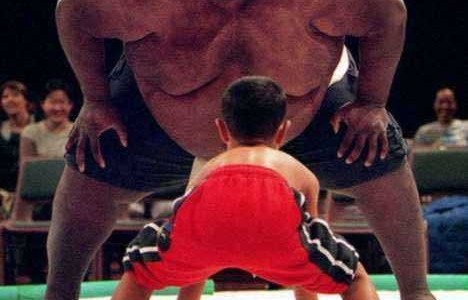
    It’s safe to say that submitting a larger opponent is not the easiest task in the world. With the attribute of strength probably not being on your side in this situation, you have to rely on other things. There is definitely a certain philosophy when it comes to submitting giants.

    The overall and very broad philosophy is this: Play to your strengths, prey on their weaknesses, and use a lot of you against the little parts of them. Sounds simple, but there’s a bit more to it. In order to play to your strengths, you have to figure out what your specific strengths are against that specific opponent. For example, as mentioned earlier, you probably are not going to be able to rely on strength to get your submission. You’re going to want to use speed, mobility, and initiative instead.

    Whether it’s how fast you can slap the submission on, or how fast you can get on the opponent’s back, or how fast you can drop back for the leg lock, you must do everything faster than your opponent if he is stronger than you, and you must do it with initiative.

    Another strength that you will have to tap into is obviously your technique. Like they always say, technique will always beat strength. That is, if your technique is sound. Learning what submissions work for you well against larger opponents is huge, and we will dive deeper into that subject as we progress in this chapter. Once you have figured that out, you must integrate those submissions into your training as much as possible.

    Drilling your giant killer submissions is absolutely essential to being able to hit them in a match or a real time scenario. If during your regular class training time, you go over techniques that your instructor teaches, but do not find time to drill certain techniques that directly relate to beating larger opponents, then it is absolutely essential that you find time to drill those additional techniques.

    Whether it be five extra minutes after class, or an extra hour of drilling with one of your training partners, any amount is better than none. Also, you must find the positions where you are more likely to hit these submissions on the bigger guys. For example, it could prove to be very difficult to attain a submission on a larger opponent from the top half guard position. There are a lot of factors that come into play in this position.

    Yes, you are on top which means you do have gravity on your side, and yes, you do have the ability to drive pressure into your opponent from the top position, but remember, the opponent still might be able to use strength to escape whatever submission you throw at him from there. For example, you could be going for an arm lock of some sort, maybe a kimura or a straight arm lock. Although you are using a two on one grip to control your opponent’s arm, who’s to say that their one arm isn’t stronger than your two from that position, even with leverage in play.

    The same thing goes for side control. Even though side control is one of the most dominant positions and opens up a world of submissions for you, who is to say that those submissions will work the same against a much larger opponent, due to the strength factor.

    A better position to attack with a submission against a bigger guy would be the back mount. For one, all four of your limbs are able to attack, and all four of your opponent’s limbs are facing away from you, giving you a much greater advantage for hitting a successful submission. As far as side control goes, your opponent is much more likely to be able to throw you off of them if they are larger and stronger. Letting your opponent turn into you and letting them think that they are in the process of escaping can allow you to use your speed and mobility to quickly spin behind them, exposing their back and opening the world of submissions for you.

    Mobility is key, guys! I cannot stress this enough, and with submissions, this comes into play big time. Avoiding positions where you have less mobility is key as well. Instead of getting bench pressed from side control, try working from the knee-on-belly position so you can potentially spin to the back or capture an arm for the armbar.

    Holding a bigger and stronger opponent down will be difficult, but being mobile and having the ability to transition quickly when they try to use their strength against you will help you avoid tough situations and will put you in advantageous spots.

    faggella

    Even the mount position can be a tricky one to hit a successful submission from. Though it’s clearly a superior position and you do have gravity on your side, you still have the possibility of being thrown off the top by a larger opponent, just like from the top half guard or side control.

    Generally, the best positions to go for submissions on larger opponents are the back mount, and any leg lock orientation as well. Being able to get to these positions faster than your opponent is a large factor in getting the submission. Another huge factor in getting the tap on a larger opponent is the concept of initial snugness. This is a sometimes overlooked concept in the realm of getting the submission, but it is very essential if you are looking to tap bigger guys.

    For example, let’s say you throw on a straight ankle lock on a much larger opponent. Even though you threw it on your opponent’s foot fairly quickly and got a semi decent grip and snugness on the ankle, they still are able to kick through it and avoid tapping out. Now let’s say for example again, that you throw on the same exact straight ankle lock, this time with very good initial snugness on the ankle, leaving no space for your larger opponent to turn his knee up or kick his foot through. The chances of you getting the tap in the second scenario are far greater than you getting the tap in the first scenario, based solely on the concept of initial snugness.

    This initial snugness is developed through consistent and conscious drilling of these submissions. If you do have certain submissions that you are drilling, it’s important to make sure that with each rep, you are getting perfect initial snugness every time. This will ensure that each time you go for a submission, the likelihood of you finishing it is much higher.

    Dan Faggella is a No Gi Pan Am Champion, BJJ Black Belt, and #1 Jiu Jitsu Best-Selling Author. Check out his full “Giant Killer” BJJ Course Online Here.

  • Immunity Course BONUS Bonanza

    Immunity Course BONUS Bonanza

    Grab Alan Belcher’s IMMUNITY Course (on sale Thursday Apr 25 @ 2pm EST – Sat before he shuts it down on Saturday night after his fight vs. Michael Bisping and here’s what I’ll hook you up with (when you grab it through this link RIGHT HERE):

    Immunity Course Bonus #1

    CAGE Cardio: Advanced Concepts for Combat Conditioning (will be sold for $97) 
    Brand New Recording of the 2.5 Hour Live Workshop [Digital Version]

    dvd-3d-webThis is the workshop I recently presented to a dozen trainers and fitness professionals where you’ll discover:

    [+] How to harness the true power of KETTLEBELLS  with exercises and programming suggestions

    [+] My current favourite ‘magic mobility’ exercises for improved, well, mobility as well as injury prevention

    [+] 3 distinct energy system based CAGE Cardio workouts: 1) Aerobic + Alactic, 2) NRG and 3) Aerobic + Lactic

    An invaluable resource for MMA Strength and Conditioning Coaches and fitness professionals serious about getting the best results for their athletes and clients.

    I’ve posted a couple of preview clips here and here.


    Immunity Course Bonus #2

    Python Power Program For Submission Strength and Stamina (sells for $57)

    group

    Follow this 6-week program and you’ll add crushing strength and crucial stamina that will help you catch more subs.

    Obviously, technique is more important.

    But when matched up against an opponent with similar technical ability, strength and stamina will give you the edge and this program will be the grappling strength and stamina edge you need.

    Click here for full details about the Python Power Program (opens in new window).

    grapplers-circuit-cover-3d
    Immunity Course Bonus #3
    TACFIT Grappler’s Circuit (Unreleased Program)

    The first 2 bonuses are already over $150 in value, but I thought I’d throw this in because it’s a fun (a relative term) circuit workout that is designed specifically to improve conditioning for grappling, based on Scott Sonnon’s TACFIT Commando program.

    It’s a couple years old now but still works just as well as when I first created, although I wasn’t as tuned into the science like I am now (which you’ll learn about in the CAGE Cardio Workshop).

    So there you have it – my Immunity Course Bonus Bonanza. After you grab the Immunity Course I suggest you start implementing my materials in the following way:

    • Read through and follow Python Power
    • Watch the CAGE Cardio Workshop
    • When you’re done Python Power, implement the Grappler’s Circuit and the “Power Burst” workout from the CAGE Cardio workshop along with a basic strength program

    Don’t forget – the only way to grab my bonus package is to pickup the IMMUNITY Course through this link right here:

    immunity-package

    Once you’ve grabbed the Immunity Course, just enter your details in the form below so I can make sure you’re tagged through my link and I’ll hook you up with everything.

    [si-contact-form form=’2′]

  • ISO Squeeze Exercise for Lactic Acid Tolerance

    To followup last post where I shared the Towel Bicep Curl exercise, I’ve got another great exercise to use to add elbow-popping submission power AND the stamina to last that I invented called the Good Morning Curl.

    But before we get to that, last post I posed the question, “Why do you think I named my new program Python Power?”

    The most powerful submission artist on the planet...
    The most powerful submission artist on the planet…

    Most of the answers described the obvious link of how the python powerfully constricts and suffocates it’s victims to death…

    Many of you also told me how once a Python gets its grips on its prey, the prey will never escape

    (more…)

  • Eric’s BJJ “Lowlights” Video?

    This was from the Joslin’s 2008 Canadian Open Grappling/BJJ tourney…

    Why do I call it a ‘lowlight‘ reel instead of a highlight reel?

    I’ll be sharing it in my next post, but watch the video and Maybe YOU can tell me:


    QUESTION: Why do you think I’m calling this a lowlight reel?

    [I’ll give you a hint – it’s not because I came in 4th instead of 1st]

    * Leave your guess in the Comments section below *

    Next post I’ll be sharing the (embarassing) truth in as well as the immediate actions I took to fix this problem PLUS a new exercise most of you have never seen before.

  • My Joslin’s Canadian Open Experience

    Sunday, November 9th was the Joslin’s tourny. If you were there, you’d have experienced one of Canada’s largest grappling tournaments.

    I participated in the 155-169.9 lbs Beginner’s (0-1 years experience) gi division. I’ve been grappling for about 4 months now and have just under 30 classes under my white belt.

    This was my first tournament and it was a really eye-opening experience. The thing that really took me by surprise was how my nerves affected me in my first and subsequent fights. After my first fight I felt like I’d been in an all-out war – but in reality I was just too ramped up and was not relaxed (or breathing?) for 5 minutes straight. In class I’ve grappled hard for 15 minutes straight and didn’t feel nearly as exhausted, but it wasn’t my muscular or cardiovascular system, it was my nervous system. Luckily I had my good friend and coach Youssef Dimassi in my corner all day – he helped me a ton with good advice, having been in the same place ayear ago.

    I’d never felt this way before in training or any athletic event in my life. There must be something about facing off against an opponent knowing that you have 1 chance to move on or go home.

    Plus, the stakes were high for me. Back in April of this year, I was talking about goal setting to a group at a nutrition workshop that I was running and I told everybody (about 25 people) that a goal of mine was to win Joslin’s Canadian Open this year. I didn’t say that I wanted to compete, I said I wanted to win.

    This was a pretty big goal, considering I wasn’t training at the time. Even then, I only started to roll in July, and from July to September I went 1-2 times a week to class. I still wasn’t really committed.

    But one thing that I’ve learned is that if you want to make a goal happen, just tell a bunch of people that you know, and once you do, that’s instant accountability. Now, I either work towards it, or look like a fool.

    Well, I didn’t win. But I came 4th in a field of 52 competitors, and I’m very happy with my performance. I got everything on video, and I can clearly see where I could have improved, but hindsight is 20/20. Here are some highlights:

    %