My little girl recently turned 5 months.
It’s been amazing watching her learn and do new things and I’ve been trying to copy all of the new movements that I see her do.
One of her latest moves is to bury her head when she’s on her tummy, lift her butt up, then push off and “crawl” one step. It’s pretty cute. 🙂
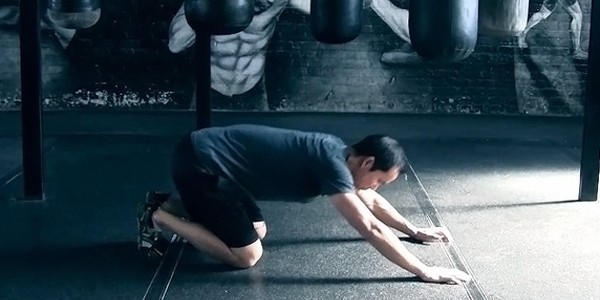
This movement is kinda like the Push Plank exercise that I teach in this video, except with the exercise you don’t scrape your face across the ground.
Give it a shot and if you want to do it like Livia, push off with one leg instead of two and alternate what leg you push off with each time or switch after 5 or 10 reps on one leg.
She’s also been steadily putting on weight and its crazy how heavy she feels now compared to when she was born.
With the added weight and all her extra squirming, it’s become increasingly more difficult to put her down to sleep in her crib at night and for naps, and I can see why many new parents complain about back pain, especially of the low back.
A couple of months ago I started to feel some LBP myself and it started as just a moderate ache and soreness….
Luckily, I was able to nip it in the bud and I’ve discovered that there are 2 keys to combating new baby back pain, which actually apply to back pain regardless of the source, so if you’ve got LBP, pay close attention:
#1. Being diligent at maintaining neutral spine and hinging at the hips vs. flexing the spine.
Because of the position of the crib, it’s easy to try and flex and bend over the rail when placing her down.
But this will put excessive strain on the discs and ligaments in your spine, which will first result in tightness and soreness in the low back muscles because they’re trying to prevent you from flexing your spine.
If you continue to move like this, the discs and/or ligaments may get damaged, which will then result in a sharper type of pain in the low back.
So if you feel tight and sore, take it as a sign that you’ve got to start HINGING at the hips and keeping your lumbar spine in neutral.
When you hinge at the hips, you’ll likely feel muscles from your hamstrings up to your rhomboids working and this is good because that means you’re taking some of the load off of your spine and the low back muscles.
TIP: DO NOT stretch your low back muscles. While it may seem like a good idea or even provide some relief, you’re just causing further damage. See Point #2 on this page to learn why stretching your low back muscles is a bad idea.
#2. Minimize the load on your low back by coming up with new movement strategies.
It’s been a cold winter so far here in Toronto and as such, we’ve had to keep little Livia moisturized by lotioning her up 2-3 times a day.
When we do this in the crib, the same problem applies in that we have to awkwardly bend over and reach to lube her up.
This situation in particular was bothering me the most so instead of bending over, what I found helped was simply dropping to one knee.
This position ensures my lumbar spine is in neutral and took all of the load off of my low back.
Now, employing these 2 keys, my back is back to feeling as good as ever.
Like I said before, these 2 keys apply to any situation that may put excess strain on your low back, so here are a few more examples to get illustrate this fact:
[+] When grabbing groceries out of the trunk of your car, really focus on neutral spine and the hip hinge or you could even brace with one arm and basically do a 1-arm row to pull the bags out
[+] If your job requires you to frequently pick things up off the ground, put some knee pads on and drop to one knee to get down instead of squatting or bending
Just a couple of ideas to get your gears grinding in case your back pain isn’t caused by a new baby.
Back pain is an all-too-common issue, so even if you don’t suffer from it now, keep these 2 keys in mind to prevent it from taking you out of action in the future.
Hope this helps.
Eric
P.S. If you’re an athlete or if you train properly with intensity (you’re an athlete, too) and you’ve got LBP, this 4-phase, 16-week program will restore your core and retrain your movements so you can participate in your sport pain-free.
![Sprints for Fat Loss | 1-Sided Low Back Pain [ASK ERIC]](https://www.powerdojo.com/wp-content/uploads/2015/04/1-sided-low-back-pain-600x300.png)
![Deadlift Back Pain | HFS + Strength | Trigger Point Fix [ASK ERIC]](https://www.powerdojo.com/wp-content/uploads/2015/02/qna4-600x300.png)
![Low Back Stretching | 1 Strength Session/Week | Fitness Trackers | [ASK ERIC]](https://www.powerdojo.com/wp-content/uploads/2015/01/img-3.png)