“Eric, do you have anystretches or exercises to help
me kick higher and develop more kick power?”
It’s one of the questions I’ve gotten most.
It’s also one of the questions that I’ve shied away from answering, because quite frankly – I can’t kick worth shit.
Maybe that’s one of the reasons I’ve stuck to boxing… [Actually, it’s DEFINITELY one of the reasons]
I attribute my poor kicking ability to my old man’s hips, which I’m guessing came from the years of hockey without any proper mobility work or even <gasp> static stretching.
That’s not to say I have no kick power… as long as the target is knee height or below.
If I ever fight a midg– errr, little person, he’d better be careful I don’t Crocop his ass, otherwise, it’s a safe bet you won’t get clubbed with a roundhouse to the head from me.
“Right Kick Hospital… Left Kick Cemetary!”
But that’s all going to change…
I’ve been working at improving my hip mobility and playing with exercises to do so and the one I’m going to show you in this video will definitely help you kick higher.
I actually came up with it when working on my hips to help me get deeper into the squat for the Olympic Lifts and realized it was a perfect exercise to improve one of the reasons my hips are so terrible – poor internal rotation mobility.
[SIDENOTE: the word “mobility” is a combination of the words “movement” and “ability”, which alludes to the fact that mobility is “your ability to move in and out of a certain range of motion”. It’s one thing to be able to get there (flexibility), it’s another to be able to move in and out of there smoothly (mobility). Just thought I’d share]
Since I’m Canadian and I grew up playing ice hockey, I call it the “Goalie Saves” exercise and when you watch the video, you’ll see why. If you’re not an ice hockey fan – after you watch this exercise, watch this YouTube video to see what I mean.
Watch the video now, then we’ll discuss details after:
When you perform this exercise as part of your Dynamic Mobility Warmup routine, the first thing is to make sure you’re doing it right.
Stop the exercise if you lose good form.
Do a total of 10 reps per side (10 on left, 10 on right), either in 1 set, or broken up into 2 sets of 5 per, or 3 sets of 3-4 per. Whatever it takes to get 10 per side.
Do it daily and you’ll see TREMENDOUS results.
So How Will This Help Me Kick Higher?
As I mention in the video, this exercise improves the ability for your femur (thigh bone) to rotate in the hip joint.
Being able to kick higher with the roundhouse requires a ton of rotation around both hips – the one that’s kicking and the one that’s planted.
If you don’t have this ability (like me) then you won’t be able to kick higher or kick with any power.
If this isn’t a limitation for you, then it won’t help.
But most people in our society have problems with internal hip rotation, so for the majority, it will help.
Of course – you need to learn proper kick technique first, so if you don’t have that, send Steven Seagal an email.
“Got Any Other Resources To Help Me Kick Higher?”
You greedy bugger. 🙂
I’ve got a few, check these out as well:
Another Hip Mobility Exercise – this will help you kick higher as it also works on your hip rotation, but more external rotation
The Jacknife – this exercise trains your hip flexors; the single leg version is particularly helpful to improve kick power
That should keep you busy for a while…
Now please, if you liked this post – LIKE IT UP using the handy buttons below. Thanks a million!
– Eric
P.S. The bottom line is that everybody from athletes to desk jockeys should use this exercise because it won’t just help you kick higher and increase your kick power, it’s also good for other things like getting into the Deep Squat for Olympic Lifting and just making your hips feel 10 years younger.
Kettlebell training is often seen as a ‘hardcore’ way of working out, but it’s just another tool in your toolbox that can be used for some specific purposes.
One thing that I love about kettlebell training is the grip strength development, especially doing exercises like swings and turkish getups.
Another benefit to mixed martial artists of kettlebell training is hip power.
Kettlebell cleans are a great exercise to use in your MMA or kettlebell training workouts for developing hip power as well as a fundamental movement if you’re using KBs to bring the bell to the rack position for other exercises like squats and presses.
But I myself have had issues when I use a heavier bell with bruising my forearms.
Results from kettlebell training… if you’re not using the tips in this post.
I even broke a watch cleaning a kettlebell one time because I forgot to take it off!
You may be thinking, “Don’t be such a pussy Eric, man up!”
The thing is if your S&C workouts either stop you from training MMA or negatively impact your MMA training, you’ve got to find ways to eliminate or minimize it.
It has nothing to do with being tough – just being smart.
So I asked my buddy Chris Lopez who is a certified kettlebell training instructor through some crazy Russian dude to show me how to clean a kettlebell properly so you don’t have to use lighter weights because you’re killing your forearms.
And of course, I filmed it for you, so I hope you enjoy the video.
I’ve made these changes to my technique and they’ve helped tremendously. I no longer beat my forearms up during kettlebell training workouts whenever I do the clean!
Right now, he’s giving away 3 additional kettlebell training workouts!…
… but this offer ends this week, so make sure you check it out and if it’s right for you, pick it up.
Now, this is NOT a fight-prep program.
It’s good for general conditioning and for learning how to perform kettlebell exercises safely and effectively.
Again – it’s just another tool to have in your toolbox and investing in educating yourself always pays off more than you pay for it, but only if you put it to use…
In addition, after you take advantage of his bonus offer, I’ll hook you up with a kettlebell circuit workout that I asked Chris to design that would be beneficial for my MMA fighters – it’s an awesome circuit and yours free when you grab Chris’ Kettlebell Revolution program.
To claim this bonus kettlebell training circuit that Chris put me through that’s designed for MMA, grab Ketllebell Revolution 2.0 then enter your invoice # on the page here.
I recently attended the 2-day course in Olympic Weightlifting with ex-Canadian Olympic team member Larry Sheppard as the course instructor.
Larry has a striking resemblance to Joe Pesci, as you can see here:
Come on – these guys gotta be twins separated at birth!
Larry was awesome at breaking down the technical details of the lifts and how to teach them effectively.
In short, the course was amazing and I learned a ton of great info that will help me help you effectively integrate the Olympic lifts into your MMA strength and conditioning program.
First, let’s talk about what exactly Olympic weightlifting is and why you might want to integrate it into your MMA strength and conditioning program.
Olympic Weightlifting is a sport comprised of two main lifts: the Snatch and the Clean & Jerk (C&J).
Here’s an example of Greek lifter Pyrros Dimas performing the Snatch (check his crazy jump height after).
This video is from the 2000 Olympics where he weighed 85 kg (187 lbs) and Snatched 175 kg (385 lbs).
I set the vid to start right before the lift for you:
And here’s the C&J, by Chinese Olympic weightlifter Liao Hui.
This video is from the 2010 World Championships where he C&J’d 198 kg (435 lbs) at a bodyweight of 69 kg (151 lbs)!
Also check his back flip after he makes the lift:
So it’s apparent that the top Olympic weightlifters in the world have a high degree of relative power – that is power output based on their bodyweight.
In the video above, Liao Hui C&J’d almost 3x his bodyweight – which is huge!
The top Olympic weightlifters can lift massive weights and move them fast, despite the fact that they’re not big guys.
But here’s the thing that you might not see: the Olympic lifts require explosive power, rapid relaxation (dropping the body under the bar) and again explosive power to catch the weight.
This timing sequence with the Olympic lifts is something not developed in other lifts such as Squats and Deadlifts.
The ability to quickly turn muscles on, off, then on again is a component of power developed in a fairly unique way through proper execution of the Olympic lifts.
Think: being able to surprise your opponent by rapidly faking a takedown by changing levels, coming up to throw a jab then dropping down again and sprinting in to score a sick double-leg.
Other benefits to Olympic weightlifting include shoulder mobility and stability, hip mobility and stability, and acute body awareness.
But it’s not all milk and honey – to get the benefits, you’ve got to ensure good technique.
More so with these lifts than others, bad technique can result in an injury.
Wrists from catching the weights in the C&J, shoulders from Snatch errors, knees from poor muscle recruitment – all stuff that can take you out of training that you must avoid.
Or this…
One of the possible pitfalls of Olympic Weightlifting
That’s why technique is king when it comes to the Olympic lifts.
There’ s no use in trying to max out the weights you’re moving if you’re beating your body up in the process.
Whenever I train a beginner in the Olympic lifts, I never, ever push the weight. It’s all about form: being smooth, fast, proper timing, etc.
So if you’re going to start Olympic lifting, make sure you focus on speed, being smooth and above all else, good technique.
And of course, I’ll have more info on how to actually do the O-lifts properly. This was just a little intro to whet your appetite. 🙂
Do you do the Olympic Lifts?
If so, let me know what kind of #’s you’re doing below:
The other day I was killing time (and brain cells) on the Facebook and came across a post Claude Patrick made to his wall that was getting some heated debate.
Claude’s post was about my buddy and colleague Daniel’s latest post on his blog about CrossFit for sport performance.
You can read Dan’s full blog post here, but the gist of what he’s saying is that CrossFit should not be used by mixed martial artists (or any other athlete) because it lacks specific, planned training and reasoning behind the workouts.
If you’re a mixed martial artist and die-hard CrossFitter, then I’m sure your blood is probably boiling instantly vaporizing right now and you’re ready to hammer out a 550 word rebuttal. Post time in the Comments. 😉
I’m pretty sure I’ve been asked whether CrossFit is good or not for MMA… I can’t quite remember because I get so many questions everyday.
Regardless, I’m going to weigh-in on this question now.
Before I sat down at my computer to write this blog for you, I was getting prepped to meet up with Mark Bocek for our first training session.
If you don’t know Mark, he’s a UFC Lightweight and he recently came off a decision loss to ex-WEC Lightweight champ Ben Henderson.
Tough fight but these are the things that build true character, no?
He’s also a BJJ ace and has won 78% of his fights by submission. [To give you perspective, Demian Maia, widely considered to be the best BJJ fighter in MMA, has won 57% of his fights by sub]
In today’s article, you’re going to discover the formula I use to ensure my fighter’s go into their fights with 100% confidence in their MMA conditioning, strength and power.
But first, a quick story…
UFC 115 was the first time I’ve cornered an athlete that I’ve trained for the big show.
Claude Patrick asked me if I wanted to be in the corner for his UFC debut and it took me about a millisecond before I said “HELL YEAH!”
Trust me when I tell you that the ear-to-ear smile that you see on my face inside the octagon in the pic below was on my face all day.
The event was held in Vancouver, BC and I arrived on the Thursday morning before the fight.
Claude won in the second round via guillotine, but that’s not what we’re going to talk about here…
As a fan, it was an awesome experience bumping into guys like Rich Franklin and Chuck Liddell in the hotel elevator, and as a strength and conditioning coach, I seized the opportunity to talk to fighters and strength coaches about what else: MMA conditioning.
I asked specific questions like, “What are your favourite methods for enhancing explosive power?” as well as more general questions like, “What do you see most fighters screwing up with respect to their MMA conditioning workouts?”
The second question fueled some interesting discussion but the general consensus was the same, although we had different ways of approaching it.
But before we get to the specific methods, here’s the general consensus shared by many of the top coaches of where most fighters are preventing themselves from getting top MMA condtioning:
Most Fighters Simply Workout, Instead Of Following A Specific MMA Conditioning Program
Here’s a simple example to clearly outline the difference between working out and following a program…
Imagine you’re trying to lose fat through diet.
Working out is like coming home from work, opening the fridge, then asking yourself, “So, what am I gonna have for dinner tonight?”
Following a program is like coming home from work, opening the fridge, grabbing the steaks, broccoli, sweet potatoes, herbs and spices and starting to prepare your dinner without delay because you knew before hand what you were going to make.
Now, ask yourself, who’s going to lose more fat, the guy ‘working out’ or the guy following the program?
That’s the difference (and power) of following a program.
So if up until now, all you’ve been doing is working out, if you’re fighting, it’s time to follow an MMA conditioning program to drastically boost your fitness so you can win more fights and I’m going to show you how you can get started right now.
Even if you’re just training MMA for fun, you might as well get the most of the training time you invest by being in top shape, don’t you think?
If your MMA conditioning is top notch, you’ll be able to handle more training vs. sitting on the sidelines watching, you’ll be more relaxed when you’re learning and be able to pickup skills faster, not to mention the fact that your coaches will definitely notice and see you’re more serious and take you more seriously.
Now, let me share the formula I’ve used with UFC fighters like Claude Patrick, Jeff Joslin and pro mixed martial artists around the world…
Eric’s MMA Conditioning Formula
Having two Chinese parents and thus being Chinese myself, naturally makes me pretty good at math.
That’s why I like concepts in formulas – it helps me remember and understand them better.
For example, I recently got married, and the advice that I got from friends and family that I remember best is “Happy Wife = Happy Life”. If you’re a married man, you might agree. 🙂
Anyway, here’s the base formula that I use for developing top-notch MMA conditioning:
Now, let me break it all down for you so you can develop Peak MMA Conditioning…
First, the order is important: Strength comes before Power, which comes before Power Endurance (PE).
These are the different methods of Resistance Training (RT), which can mean anything from lifting weights to bodyweight training.
A high level of MMA conditioning means having a high level of PE, because it’s one thing to have knockout power, it’s another thing to have knockout power that lasts for 2 minutes then is gone for the rest of the fight.
And to be powerful, you first have to be strong.
The vertical jump is one of the purest examples of power and Kelly Baggett, the foremost coach when it comes to increasing your vert, recommends you have a max Back Squat of 1.5 times your bodyweight before even thinking about doing plyometrics.
I couldn’t agree more.
So first, your goal is to get your Strength up, then you work on your Power and only then do you work on PE.
Now Cardio is what I use to specifically target the heart and lungs vs. the muscles.
Typically, Cardio is some type of cyclic movement, so I define riding a bike and running as Cardio and bodyweight circuits as PE.
You’ll notice that Cardio is underneath Strength, Power and PE in my MMA conditioning formula…
This is because you can develop it at the same time as the other elements. [There are different Cardio training goals and methods such as aerobic power intervals, anaeorbic threshold training, etc that work in synergy with each other, but that’s beyond the scope of this article and for another day]
For guys a little out of shape or fighters who have only been doing mainly circuit training and not too much RT, if you’re training MMA 3+ days per week, they can serve as your Cardio workouts while you focus on RT.
When to bring specific Cardio training into the mix depends on the individual, how much training time you have, how good your nutrition is, etc, but simply know that eventually, you’ll get to the point where you’re training Cardio and RT in the same cycle of your MMA conditioning program.
Now do you see the difference between going to the gym for a workout and following a program designed specifically to boost your MMA conditioning?
“So What Do I Do Next?”
If the only thing you get from reading this article is that you’ve got to start following an MMA conditioning program, then I’ve done my job and you’ll get in better shape than before, I guarantee it.
The reality is that ANY program, even one that’s poorly designed, will outperform simply going to the gym to workout, so even if you put it together yourself, you’ll be ahead of most of the guys out there.
The important thing is to have something in place that you follow and progress instead of doing whatever you feel like doing.
BUT if you’re a fighter or you train MMA for fun and you want to be in top shape, I’ve put together the Ultimate MMA Strength and Conditioning program based around the MMA conditioning formula I’ve shared with you in this article AND best of all, it’s been PROVEN the only place it counts – inside the octagon. Find out more here.
Thousands of other fighters have followed this program with tremendous results (that you can read about here), but when you follow the program and it doesn’t work for you, email me and you’ll get your money back. I don’t want your money if the program doesn’t work, but because I know it will, I can offer you this guarantee.
If you keep working out instead of training and following a program designed specifically for MMA , you’re stopping yourself from reaching your potential as a fighter and athlete.
Every day is a chance to get better or get worse, you’re never maintaining because if others are getting better, you’re getting worse.
So start training on a specific MMA conditioning program that’s proven to work and you’ll win more fights and have way more fun training mixed martial arts than ever before.
OK so we got 100+ Comments on Part I of the MMA Altitude Training Device Review, which tells me you guys have seen the ads and heard the hype and really want to know…
Are Altitude Training Devices Worth It?
To recap, this is where we left off last time:
“There are no studies on MMA specifically, so I had to search LONG and HARD to find something that would at least come close.
This took me FOREVER, because most of these altitude studies are done on endurance sport athlete such as runners, cyclists and cross-country skiers.
But lo and behold, I stumbled upon one, a moment before my eyes were about to explode from reading these cryptic journal articles all day. Scientists reading this – why can’t you write in normal English!”
Lately, I’ve gotten a number of questions about various devices that you put in your mouth or wear over your mouth and/or nose that purport to simulate altitude training my fighters, customers and subscribers.
You might’ve seen people using various devices on YouTube or other places.
When I get multiple questions about something, I know it’s time to roll up my sleeves, pull out my library card and do some down and dirty research.
If you don’t know what I’m talking about, they basically restrict your breathing, which is supposed to simulate training at altitude.
Various claims are made about these devices, such as:
Increased lung capacity
Improvements to something called your Anaerobic Threshold
More energy
Improvements in physical and mental endurance and mental focus… and many more.
WARNING: we’re going to get a little technical here, so if you have absolutely no desire to talk science with me, then skip to the Conclusion at the bottom of this article for the answer to the question, “Will using these devices improve my performance?”
Otherwise, into the rabbit hole we go…
The first question you should be asking here is…
“What is Altitude Training and How Might it be Beneficial for MMA?”
To understand the science behind altitude (elevation) training, you must understand the following definitions; otherwise you’ll be lost at sea without a paddle.
Anaerobic/Lactate Threshold
The intensity of exercise at which your body begins to accumulate lactic acid*; at this point, energy production shifts from aerobic (unlimited energy) to anaerobic energy production (very limited)
*NOTE: this is not entirely correct but I’m not going to waste time here explaining what lactic acid is and what really causes fatigue, the main concept is still the same, so if you’re a science geek getting ready to call me out, don’t bother, it won’t help you, me or anyone else reading this
VO2 Max
The max amount of oxygen your body can make use of for fuel; often used in studies as a test for aerobic fitness, although it’s not often the best indicator of actual sport performance; often expressed as either 50 ml O2/kg bodyweight/min, or 5 L O2/min, either way, HIGHER is BETTER
Hypoxia
When the air you breathe contains less oxygen than normal
Air
The stuff you breathe did you really have to click this one? lol; composed of about 78% nitrogen (N2) and 21% oxygen (O2) at every altitude
Altitude
Refers to elevation above sea level where the air is less dense, and thus contains less oxygen because there are fewer particles in the air overall; % of oxygen remains the same as at sea level; two major variables are manipulated, where you train (High or Low) and where you train (High or Low), thus, the following combinations exist and have been thoroughly studied:
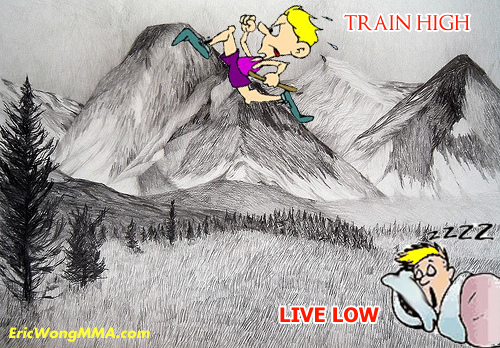
Train High Live High (THLH)
Train Low Live High (TLLH)
Train High Live Low (THLL)
Train Low Live Low (TLLL – what most of us do all the time)
Some popular altitudes:
Boulder, Colorado, USA: 1650 m
Whistler, British Columbia, Canada: 652 m
French Alps: 2500 m
If you want to see how exactly how dense air is at a certain altitude, check this link out:
Now that you’ve got the basics let’s talk altitude training…
Altitude training is based on the premise that when you’re at altitude, there’s less oxygen in the air, making exercise a lot harder. The higher you go, the less oxygen there is, the harder exercise is.
Because of this, it’s theorized that altitude will force your body to adapt increase your red blood cell (RBC) count and thus improving aerobic performance, delaying onset of anaerobic energy production and improving recovery.
The bottom line is that…
More Red Blood Cells = More Oxygen (to feed your working muscles with)
This is important – remember it, you’ll need this knowledge later.
This is the theory, anyway, but lucky for us, it’s been rigorously tested by scientists from around the world.
Some cool sports science history – altitude training gained huge popularity after the Olympic Games in 1968 which were held in Mexico City1.
Mexico City is at an altitude of 2300 m, so for those athletes who weren’t prepared for this, it was a huge shock and the exercise physiologists were put to work to figure out how to use this to their advantage.
Now, as mentioned in the Altitude definition above, there are 3 main combinations of altitude training that have been studied: Live High Train High, Live Low Train High and Live High Train Low.
With respect to these devices, if it’s supposed to mimic training at altitude and you wear it during your workouts, this would be similar as Live Low Train High (LLTH), since during your workout, you’re ‘training’ at altitude and the rest of the time you’re at your normal altitude.
So we’re going to focus on the studies that test LLTH and forget about the rest.
[For now, maybe if you’re really interested, I’ll discuss the others a future post. Let me know in the Comments if this is something you’d be interested in reading]
“… A common feature of virtually all studies on “live low–train high” is that hypoxic exposure only during exercise sessions is not sufficient to induce changes in hematologic parameters. Hematocrit and hemoglobin concentrations usually remain unchanged with “live low–train high.”
“What does this mean for YOU as a Mixed Martial
ArtistLooking for Peak Performance?“
So, do these devices actually increase red blood cell production and improve oxygen delivery to your working muscles as claimed?
When Vogt and Hoppeler talk about “hematocrit” and “hemoglobin”, they’re basically talking about RBCs. For your purposes, hematocrit = hemoglobin = RBCs. For each, more is better.
If you don’t know what RBCs, hematocrit or hemoglobin are, here are some definitions:
Cells in your body that are responsible for transporting oxygen where required; the more red blood cells (RBCs) you have, the more oxygen you can transport to working muscles
Hematocrit
Refers to the % of total blood that is made up of RBCs; more is better (to a point, if your blood gets too ‘thick’ you could die but this will never happen through training, only drugs)
Hemoglobin
The specific component of a RBC that carries the oxygen.
Let’s do an analogy – it’s kind of like if you were carrying a backpack that had your boxing gloves in them, you are the RBC and yes, you’re carrying your boxing gloves, but to be more precise, your backpack is actually carrying your gloves…
Well, your backpack is like Hemoglobin. Get it?
If not, I don’t blame you, the analogy sucked. Leave me alone – it’s late.[/features_box_azure_blue]
So Vogt and Hoppeler state that LLTH (altitude training) does NOT improve red blood cell paramaters, which means that performance does not improve either. But let’s look at some hard data, just to make sure, OK?
There are no studies on MMA specifically, so I had to search LONG and HARD to find something that would at least come close.
This took me FOREVER, because most of these altitude studies are done on endurance sport athlete such as runners, cyclists and cross-country skiers.
But lo and behold, I stumbled upon one, a moment before my eyes were about to explode from reading these cryptic journal articles all day. Scientists reading this – why can’t you write in normal English!
How I looked and felt slaving through journal articles on my computer.
AND this is where we have today’s cliffhanger… 😛
I put a lot of work into this article, as you can tell from this first half…
So if you want the Conclusion, I want to see 100 Comments letting me know that you want to see it, otherwise, into the vault it goes!
I’m 100% serious – if we don’t get at least 100 Comments, you won’t see Part II.
– Eric
P.S. I give you the straight goods about the various altitude simulation devices, so if you want to know if it will improve your performance or not plus some extra data I uncovered from an unlikely source, leave a Comment below:
Today’s MMA workout video is in celebration of the first weekend of July holidays…
This past weekend us Canadians celebrated Canada Day while our neighbours to the south celebrated Independence Day.
Basically that means a lot of fireworks and beer.
I was lucky to be able to hit up the cottage again (2 weekends in a row!) and had a great time.
I brought my trusty 24kg Kettlebell and TRX with me to get some workouts in while I was away and workouts I did!
Unfortunately, the deer flies were out in full force and were attacking me despite being drenched in Citronella, which, as I’ve discovered, has zero effect on deer flies.
Who knew?
Oh well, at least I smelled lemon-y fresh during my workout!
The two exercises I’m going to show you in today’s video are good for 3 things:
Increasing PUNCHING POWER via rotational hip power and core stability
Decreasing SHOULDER INJURIES via compensatory strengthening to balance the demands of MMA training
Increasing GRIP STRENGTH
Not too shabby eh?
Plus, all you need is a Kettlebell and TRX.
NOTE: I like to have fun with my videos. If you want some serious, stuffy dude who likes to talk over your head, go elsewhere. Otherwise, enjoy and most importantly, put it to use. Check it:
Here are a few more details about each exercise:
The “Electron”
This exercise is great because you work the KB through a circular range of motion, which is fantastic for the shoulders and develops hip power and core stability in the rotational (transverse) plane of motion.
Enter 3D training with this exercise! It can be done for reps (10 per), time (60 sec or any other method you want to use.
The “Scarecrow”
This TRX exercise will balance the demands on your body if you train MMA by training your upper back muscles and posture, helping you decrease injuries.
Go for higher reps here, 10-20 is a good number to shoot for, so you can focus on perfect form and develop strength-endurance and maybe even a little upper back muscle mass.
So…
Whaddya think of the exercises?
Most importantly, what’d you think of the fish? 🙂
If you have no questions or Comments, simply introduce yourself and tell me where you’re from.
It’s cool to see the different parts of the world where people are visiting my blog from.
Today’s society is taking a MASSIVE toll on our bodies…
Many of us park our butts in an office chair for 8 hours a day mulling over spreadsheets or plugging away inside Outlook…
Others are road warriors who spend a couple of hours traversing the land in the modern-day horse and buggy called the car.
Not to mention our hobbies, one of which, if you’re reading this blog, is likely mixed martial arts training, with its guard, clinch, single and double leg takedown attempts, chin-tucked fighting stances, shoulders rounded forward like a turtle’s shell, abs constantly on to make the body as small a target as possible.
I know it's not MMA, but it's a perfect example of what I'm sayin'…
Our bodies, which are almost a thing of perfection – the strength, power, athleticism, quickness and grace with which we move in the upright position and with good posture is something truly amazing – are regressing and de-volving to the point that Darwin would be afraid for our species’ (modern man) survival.


 BUT if you’re a fighter or you train MMA for fun and you want to be in top shape, I’ve put together the Ultimate MMA Strength and Conditioning program based around the MMA conditioning formula I’ve shared with you in this article AND best of all, it’s been PROVEN the only place it counts – inside the octagon. Find out more



 Unfortunately, the deer flies were out in full force and were attacking me despite being drenched in Citronella, which, as I’ve discovered, has zero effect on deer flies.
 Many of us park our butts in an office chair for 8 hours a day mulling over spreadsheets or plugging away inside Outlook…