Medicine balls aren’t the only tool you can use to train your chin. Do 3 sets of 10 reps for 2 weeks and you’ll never get knocked out again!
Author: Eric Wong
-
IQMMA Review
I was at the Iroquois MMA Championships this past weekend and I must say that I probably won’t be going back unless there is a very, very good card lined up.
I’m all for MMA in Ontario, but I don’t want to be a part of something that gives MMA a bad name, as I feel it’s already fighting an uphill battle in this province to get regulated.
Now they are doing some things very well. I mean the big screens and sounds system is pretty impressive for an event of this size.
But that’s about all I’m impressed with.
First of all, this was the second time I’ve been to one of these shows, and both started late (1 hour +). This just stinks of a lack of professionalism and respect for people’s time.
Unfortunately during the first fight, one fighters was badly hurt by an illegal elbow to the back of the head. Making things worse, the ref didn’t stop the fight and allowed the attacker to continue to drop bombs on his hapless opponent. The result – 45 minutes waiting for the ambulance to arrive and a mixed-martial artist who could’ve possibly been permanently injured.
Because of the lack of good refereeing, an athlete might be suffering for the rest of his life and the anti-MMA bandwagon may have just gotten some good ammo to keep MMA out of Ontario.
The rest of my problems are going into bullet points because I don’t feel like writing a 20 page essay:
- They have a very long intermission. What MMA show has an intermission?
- 2 Muay Thai fights instead of getting more of what we want, this is IQMMA not IQMMA+MT
- Most fights ended quickly in the first round, showing poor match-making
- They brought in two comedians who did 2 little performances that had me want to put myself into a rear naked choke and not let go
That’s all I have to say. I could say more but I’m getting depressed.
But at least the ring girls were pretty hot.
-
Rope Ball Exercises for Developing KO Power
If you want to develop knockout power with your strikes, then the first thing you need to do is learn the proper technique. It’s not about slugging your opponent, it’s about the snap. Nobody teaches this better than my man Jeff Joslin.
Once you have your technique down, then it’s about training specific exercises that will allow you to maximize your skills. But most traditional gym exercises like bench press leave out a key component for developing KO power, which is improving your power in the transverse (rotational) plane.
Striking power comes from rotating the legs/hips/core into the punch, and finishing with the fist. That’s where rope ball exercises come in. You’ll not only specifically target the transverse plane, but you’ll also train that ‘snap’ that is necessary for KO power. Medicine ball throws are good as well, but the rope ball is what you need to really take it up a level. Check out two of my favourite exercises in this video:
-
My Joslin’s Canadian Open Experience
Sunday, November 9th was the Joslin’s tourny. If you were there, you’d have experienced one of Canada’s largest grappling tournaments.
I participated in the 155-169.9 lbs Beginner’s (0-1 years experience) gi division. I’ve been grappling for about 4 months now and have just under 30 classes under my white belt.
This was my first tournament and it was a really eye-opening experience. The thing that really took me by surprise was how my nerves affected me in my first and subsequent fights. After my first fight I felt like I’d been in an all-out war – but in reality I was just too ramped up and was not relaxed (or breathing?) for 5 minutes straight. In class I’ve grappled hard for 15 minutes straight and didn’t feel nearly as exhausted, but it wasn’t my muscular or cardiovascular system, it was my nervous system. Luckily I had my good friend and coach Youssef Dimassi in my corner all day – he helped me a ton with good advice, having been in the same place ayear ago.
I’d never felt this way before in training or any athletic event in my life. There must be something about facing off against an opponent knowing that you have 1 chance to move on or go home.
Plus, the stakes were high for me. Back in April of this year, I was talking about goal setting to a group at a nutrition workshop that I was running and I told everybody (about 25 people) that a goal of mine was to win Joslin’s Canadian Open this year. I didn’t say that I wanted to compete, I said I wanted to win.
This was a pretty big goal, considering I wasn’t training at the time. Even then, I only started to roll in July, and from July to September I went 1-2 times a week to class. I still wasn’t really committed.
But one thing that I’ve learned is that if you want to make a goal happen, just tell a bunch of people that you know, and once you do, that’s instant accountability. Now, I either work towards it, or look like a fool.
Well, I didn’t win. But I came 4th in a field of 52 competitors, and I’m very happy with my performance. I got everything on video, and I can clearly see where I could have improved, but hindsight is 20/20. Here are some highlights:
-
WARNING: Be Aware of Bad Advice
The Joslin’s Canadian Open grappling tourney is coming up this weekend, and I’m getting ready for it along with a bunch of others.
I was talking with a buddy of mine at the dojo yesterday and he was asking me about carb loading. Carb loading is a method of altering your carbohydrate intake to maximize how much glycogen (stored form of carbohydrate in the muscle for energy) your body can store in the muscle for a specific competition date.
In effect, you can trick your muscles into storing more glycogen through proper application of the principles carb loading. Having more glycogen in the muscles is highly beneficial to a competition like a BJJ tournament because the anaerobic lactic energy system is heavily relied upon, especially if you’re winning and fighting 4, 5, or 6 matches in one day.
He mentioned to me that a personal trainer at the gym he goes to told him that to carb load, you don’t eat any carbs the 2 days prior to an event, while loading up on carbs the 3 or 4 days previous to your 2 non-carb days.
I just shook my head and basically said to follow the exact opposite of what the trainer said to carb load properly.
Without even going into the science of the topic, just think about it logically.
If you follow Joe Dumbass’ carb loading scheme, you take in excessive carbs for 2-3 days. The body, wanting to keep at a certain normal level, then increases the rate at which you burn the carbs, normalizing the level in your body. You’ll also put on a little fat doing this, because once the muscles are full, the carbs have to go somewhere, which is towards energy use and fat storage.
Now, because your body is used to processing carbs faster, if you suddenly go low carb for the 2 days right before your competition, your glycogen levels will go below their normal, due to the upregulation in carb utilization. This is exactly what you DON’T WANT. Makes logical sense, right?
Instead, what you want to do is go low carb for 2-3 days, on top of exercise, thus depleting your muscles stores of glycogen. Then, the 2 days prior to your competition, load up on the carbs, while keeping exercise intensity low to moderate.
Because your muscles are depleted, they’ll be starving for carbs, and when you eat them, they’ll soak them up, and more. So for competition day, your muscles (and liver) will have more glycogen than normal.
So anyway, before following anyone’s advice, even if it comes from a supposed expert, the first thing to do is to think logically about it. If something doesn’t seem to make sense, then ask someone you trust or do your own research before coming to a decision on what to do.
I just hope Joe Dumbass is grappling this weekend so he can gas out in after 3 or 4 minutes and someone can choke him out and put him out of his misery.
-
What to Learn from Patrick Cote’s Knee Injury
If you got a chance to catch the UFC on Saturday night and saw Patrick Cote’s knee injury when he was fighting the Spider, you were probably disappointed that the 2 warriors didn’t get a chance to properly finish what they started.
I sure was. I love getting a chance to watch Silva at work, and I thought Cote showed that he definitely has a chin.
But what I want to talk about is the knee injury that Cote suffered.
You could see the shin bone kind of move forward and out laterally when he hurt himself. In some interviews he said that it’s an old meniscus, but from the way it looked, I believe that he hurt his ACL. Often with a buckling type injury, it’s a ligament that gets damaged.
The ACL functions to stop the shin (tibia/fibula) from sliding forward under the thigh bone (femur), but only when the muscles aren’t there to do their job.
PICTURE it this way: put your right fist up like at the top of a bicep curl, then put your left fist on top of your right fist. When you slide your right fist forward towards the computer screen, that’s the movement that the ACL prevents, and that’s what happened to Cote’s knee.
So the ACL will come into play in a really quick pivot type move, like a running back who cuts hard, or during something unexpected, like getting pushed right before you land from a jump.
The ACL will also work to stabilize the joint if the muscles aren’t strong enough to do the job, so even if you’re expecting the movement or it’s a planned movement, like a hard cut in football, if you don’t have strong muscles, you can still tear your ACL.
To prevent ACL injuries, you need to make sure your hamstrings and calves are strong and powerful. So exercises like Stiff-leg deadlifts and Swiss ball leg curls are crucial to knee injury prevention. The muscles worked in these exercises do exactly what the ACL does, prevent anterior slide of the lower leg on the upper leg. These exercises are all a part of my MMA Strength and Conditioning program.
So the lesson to learn here is to keep the muscles strong, but even more importantly, powerful. The muscles need to be able to react quickly, so doing exercises such as repetitive, explosive jumps like squat jumps and others found in my NRG system complexes will train this quality.
Well that’s it for now, hope you enjoyed the rest of the UFC and I’ll talk with you soon.
-
The Lost Ingredient to Recovery
After popping my rib grappling on Saturday, I decided to take Sunday off. That lead me to this post.
There’s one thing that a lot of fighters totally screw up, and that’s recovery.
Recovery is not just ‘not training’ but can mean a lot of things:
– Enough quality sleep
– Nutrition including adequate high quality fats and protein
– Active recovery modalities such as massage and contrast showersBut one thing that a lot of people in general miss out on is mental recovery. From this I mean ‘unplugging’ yourself from all of the things on your mind and all of the madness of mainstream society like TV, newspapers, malls, and anywhere else your mind gets bombarded.
You probably don’t realize it but you’re being hit with 1000’s of messages everyday telling you to buy this or that this is the best offer.
You need a break from this once in a while! I decided to take a break by going for a long hike on a beautiful sunny Sunday. Check out some of the highlights:
 The entrance to the hike.
 Some nice light.
 Don’t worry, he’s not poisonous!
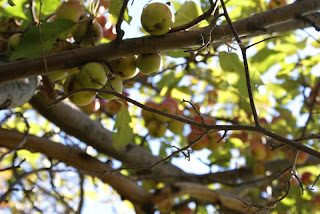 The hike even came with free snacks.
 My new ‘Walden Pond’.So if you haven’t ‘unplugged’ yourself for a while, I urge you to go for a 1 hour or more hike, somewhere not so busy, and let your mind be refreshed, giving you an edge in training.
 -
Medicine Ball High Intensity Interval Training
Thought I’d make up for last post’s little joke exercise and give you something real.
Here’s a simple little workout to do instead of standard 1 min hard, 1 min easy running for your interval training.
Using the medicine ball for side tosses integrates core power in the transverse (rotational) plane (think punches, kicks, throws), and the back tosses train your triple extension (think posturing on the ground and takedowns while standing). So you get some MMA-specific movements while doing intervals. Nice!
-
Crazy Medicine Ball Exercise for MMA
Hey Guys,
This is the most amazing medicine ball exercise for MMA that I have ever learned.
Do 10 reps of 4 sets, 60 seconds rest between sets and you will feel like a new fighter:
-
The Inferno LIVE – Thursday’s at 10pm
Jeff Joslin is hosting a live web show (PG-13) every Thursday at 10pm. I’ll be a special guest tonight (if I can get my webcam working).
Check it out at: http://joslinvideo.blogspot.com/
He’s got a contest running, so if you want to join, you have to have a proper name and e-mail signed up, just go create a free account at
and you’ll be eligble for the contest.


