Tag: deadlifts

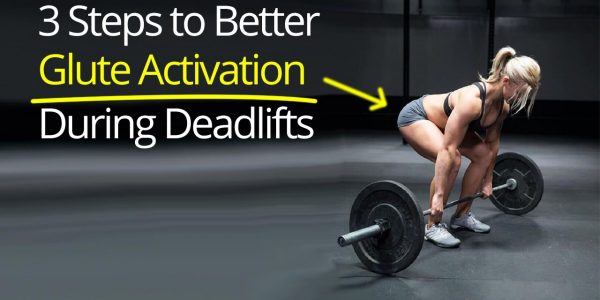
  • 3 Steps to Better Glute Activation During Deadlifts

    3 Steps to Better Glute Activation During Deadlifts

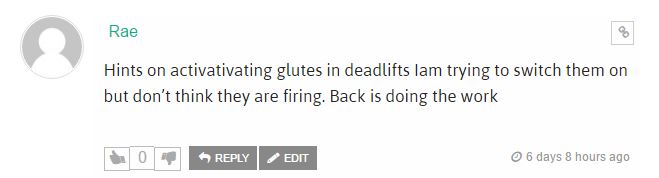
    I recently got this question about glute activation from a VIP subscriber:
    deadlift-question

    This is a very common situation people find themselves in because our glutes are often sleepy because we sit on them all day and it’s particularly difficult to get the glutes firing during Deadlifts.

    There’s another point about glute activation that relates to your hip flexors that a lot of people don’t know, but we’ll cover this after the video.

    Speaking of which – the 3 step approach I outline in the video will help get sleepy glutes firing again and you can apply the same philosophy behind the approach to help get ANY muscle group that’s not firing to work better.

    So if you’ve got other muscles that don’t work properly, like your lats, rhomboids or even your obliques – you can use the same thinking to achieve your goal.

    Check it out now:

    To summarize the 3 steps to better glute activation during Deadlifts:

    1. Get the glutes SORE, so you can easily feel them working when Deadlifting. I suggest doing Bulgarian Split Squats to achieve this. Do 3-4 sets of 10-12 reps per leg.
    2. When your glutes are sore, do some Deadlifts, but start with 2 specific activation exercises, the 4 Point Hip Extension (open chain) and the Wall Hip Bridge (closed chain). Do 4-6 reps and hold for 5 sec, squeezing those glutes hard. It’s also fun to explore other movements and how they feel when your glutes are already sore, for example – Squats.
    3. Get into your Deadlifts and start just with the hinge movement while focusing on glute activation. Slowly ramp up and only go as high as you can while maintaining glute activation. It may be lower than your max, but if your goal is glute activation, this is the way to go and you’ll progress from here.

    Now, let’s go into what I I mentioned about sleepy glutes and hip flexors – if your glutes aren’t firing properly, you’re likely going to have tight hip flexors.

    The reason why is because your glutes create hip extension and when they don’t function properly, you’ll lose this hip extension and the hip flexors will compensate and tighten up.

    The old “use it or lose it” principle.

    When your glutes are firing well and you can go into full hip extension, your hip flexors get STRETCHED to their limit and this helps maintain full range of motion.

    Make sense?

    This is part of the reason why the Hip Flexibility Solution program works so well to loosen up tight hips – because it’s based on building flexibility through greater strength in the end ranges of motion.

    If you have tight hips, you’ll have to address the problem holistically, otherwise you’ll constantly be frustrated because you’ll stretch until the cows come home but will never gain any lasting results.
  • Squats vs. Deadlifts – Which is better?

    Squats vs. Deadlifts – Which is better?

    I’m going to answer a couple of questions I got from readers here today…

    The first question I got was about Squats and Deadlifts and which exercise is better.

    I can’t remember who asked me this question. Perhaps I’m still a little foggy from my birthday weekend. I just turned 32.

    I’m guessing the question was really, “If I had to choose, would I rather do Squats or Deadlifts?”

    First of all, these questions aren’t very useful because they assume you can only do 1 exercise, which is obviously not the case.

    You can and should do both, as they are both key exercises to develop your strength.

    But I’d like to share some of the different benefits of each exercise, some of which I’m betting you’ve never considered before…

    Squats give you better overall development of your your legs and hips, hitting your glutes, hamstrings and quads. While both work your torso stabilizers. the Deadlift puts more emphasis on your posterior chain, which includes your hamstrings, glutes and back muscles.

    With respect to Squats, one big thing that’s not talked about as a benefit is that there’s nothing that can replace the feeling of confidence of having a shitload of weight on your shoulders, getting down low and successfully making it back up.

    Sure, getting your chest crushed from a Bench Press failure sucks, but as an inexperienced bench presser, you’re probably not pushing enough weight to do much damage.

    Like me, you’ve probably had this happen to you when Bench Pressing at some point in your life:

    You’re on your last set of Bench. You don’t have a spotter and you want that last rep to really build up your pectorals so the girls will notice (and hopefully try to cop a feel).

    You get to the last rep, think you got it, lower the bar, make it about 1/4 of the way back up then think, “Uh. Oh.”

    You rest the bar on your chest, hoping to recover, but the elimination of the stretch-shortening cycle combined with your fatigue makes it impossible to get it off your chest.

    So you roll it down your torso, being extra careful as it approaches your naughty bits, sit up and lift the bar off of you, trying to avoid eye contact with those who noticed your epic failure.

    Trust me, I’ve been there. Done that.

    Now that I’ve got more experience, I don’t fail on the Bench Press, or if there’s a chance I might, I have a spotter.

    Failing on the Bench Press sucks, but it wouldn’t suck nearly as much as being crushed underneath a barbell from a failed squat. So many more things can go wrong…

    Thus, the element of fear, and more so, the resulting confidence of overcoming that fear to successfully Squat a serious weight is a real benefit unparalleled by any other exercise.

    You come out of a heavy Squat set feeling like a real MAN.

    With the Deadlift, there’s no fear of getting crushed. You can simply drop the bar.

    So this is one reason why you definitely want to Squat – to build confidence, which is your ability to take action in the face of fear.

    In the Deadlift, because you’re grabbing the bar with your hands, obviously grip strength is required, which the Squat doesn’t require much of (gripping the bar a bit tight does help with keeping your upper back tight).

    One unique Deadlift benefit occurs only when you learn really good technique and understand what it’s supposed to feel like.

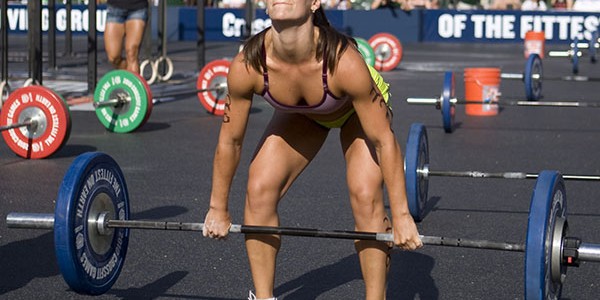
    How could I not use this picture?

    When you do a good Deadlift, you can feel the integration and ‘tightness’ starting from your feet, moving up through the legs, between your shoulder blades, up through your arms and into your hands.

    You really get to feel how every muscle in your body is linked and can work together.

    This total body integration and ability to feel your the muscles from toes to fingers work together is a unique feature of the Deadlift that benefits all athletes.

    Good form is key though, because if you’re loose at any point up the chain, you’ll lose this feeling and you won’t get this benefit.

    Hope that gives you some new insights into 2 of the most important strength exercises you can do.

    If you’re a fighter or you train MMA, you’ll see these exercises in my Ultimate MMA S&C program and exactly during what phase of training to do them and how many reps and sets to perform for maximum benefits.

    I also got a question about the MMA Ripped program from Dan Mercorelli asking me how long the workouts are.

    There are 4 workouts per week in MMA Ripped: 2 x Strength + Cardio workouts, which, including the warmup, would probably take around 55-75 mins, depending on the week.

    Then there are 2 x Bodyweight workouts, ranging from 30-40 mins including warmup.

    The program is periodized so the # of sets and reps and stuff goes up and down throughout the program, ensuring that you avoid overtraining and plateaus.

    Oh and the difference between Ultimate MMA and MMA Ripped is that Ultimate MMA is designed for guys training for an MMA fight or who train MMA at least a couple times a week. It only requires 2 days/week so it can be fit into a busy schedule.

    MMA Ripped is designed more for guys who don’t train MMA, or don’t train it too seriously, as It takes a bit more time.

    That’s it for now.

    Talk soon,
    Eric

    P.S. If you’ve got a question about anything I’ve talked about here or any other training/nutrition topic, the best place to ask is either in the powerDOJO forum if you’re a member, or on my Ask EricWongMMA page here.

  • 3 Keys to Explosive Takedowns

    First of all, to make sure we’re on the same page, these are what EXPLOSIVE takedowns look like:

    [flv:http://ericwongmma.com//videos/explosive-takedowns-mma.flv 480 320]

    Before we get into talking about the physical abilities needed to execute takedowns like these, you’ve got to learn perfect technique.

    So learn the technique perfectly, then drill it over and over until you don’t have to think about it.

    Once you’ve got the technique down, your physical ability will determine whether you’ve got the speed and power to pull it off in the cage or if you’ll be stuffed.

    Here are the 3 keys you need to focus on for maximum takedown power.

    (more…)