Tag: thoracic spine

  • The Deep Squat Wall Walk

    The Deep Squat Wall Walk

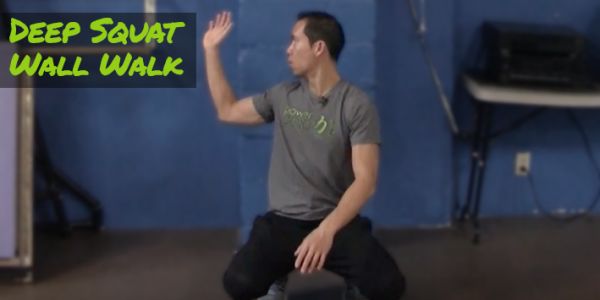
    In today’s drill that I call the Deep Squat Wall Walk, we’re going to bring together the 2 separate elements that we worked on in the previous 2 posts on the blog (Deep Squat Pivot, T-Spine Exercises), which are deep squat mobility and thoracic spine extension.

    This is an example of how we progress techniques – we build basic levels of ability separately, then put them together.

    This also increases efficiency since we’re essentially killing 2 birds with one stone.

    So we’re going to build strength out of the deep squat position today, specifically targeting the rectus femoris, which is a 2-joint muscle that causes hip flexion and knee extension.
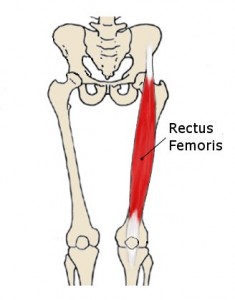
    rectus-femorisThe rec fem is a muscle that is not thought of much and when we do think of it, the common thought is that it’s always tight and needs to be stretched.

    But as I’ve been trying to hammer home over YEARS – flexibility and mobility is not just about stretching and lengthening tissues – it’s more about building strength in new (end) ranges of motion.

    This is true especially as we get older…

    …because tightness often occurs as a response to muscle weakness to increase joint stability and if we just stretch without restoring strength, we’re actually decreasing joint stability which is counter to the goals of our nervous system (stable, safe and healthy joints).

    So this exercise is going to help build strength in the rec fem and other quad muscles out of the end range of knee flexion, as well as improve overhead shoulder mobility and thoracic spine extension.

    Go for anywhere from 4-10 reps pre or post workout and you’re good to go.

    And before you go I’m wondering – do you have any specific pain right now that impairs or prevents you from exercising?

    If so, let me know what it is below as I’m gathering ideas for future videos.
     

  • 2 Exercises to Fix Your Stiff T-Spine

    2 Exercises to Fix Your Stiff T-Spine

    Your spine is designed to move…

    Well, maybe not if you’re dressing up as Frankenstein today for Hallowe’en, but every other day your spine should be doing what it’s made to do.

    frank

    If the spine was designed to be like a stiff rod, there wouldn’t be 7 cervical, 12 thoracic and 5 lumbar vertebrae that can move in every plane of motion through flexion/extension, side bending and rotation.

    Instead, we’d simply have a single bone, like other body segments that aren’t supposed to move such as the femur and humerus.

    But no, we’ve got a spine made up of many different
    joints that are ALL designed for MOVEMENT.

    Modern day life has our spine either straight or flexed most of the time and because we spend so much time there, our bodies adapt and adopt it as the norm, hence all the people who like depressed with their hunch backs walking around.

    And because we don’t use our ability to extend and rotate our spines, we lose it.

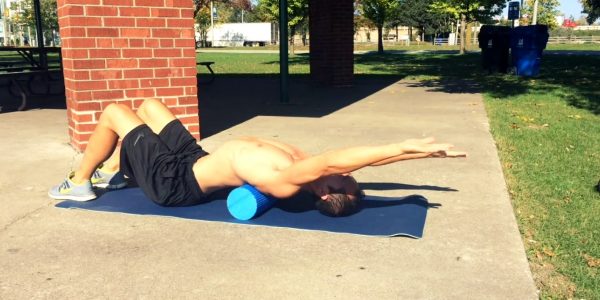
    Well, the 2 new exercises I’m sharing with you today that use the foam roller (something we should all have at home) will help you get your extension back.

    The first drill gets you to your full thoracic extension (whatever that may be for YOU), then builds strength there, specifically in the spinal extensors like the multifidus and those little-known spinalis and longissimus muscles.

    That’s how you gain and keep new ranges of motion: you build strength at that range.

    This is a critically important point, hence the bolded text.

    If you simply achieve a new range of motion through stretching, you will quickly lose it because without strength in that range, your central nervous system (CNS) sees that range as weak and unstable and any range that’s weak and unstable is a risk for injury, which your CNS doesn’t want (it likes you, it really likes you).

    That’s one of the concepts at the core of my Hip Flexibility Solution and Shoulder Flexibility Solution programs.

    The second drill will build active strength to get you to your full range of thoracic spine extension by actively contracting the lower and middle traps and rhomboids, which will also result in co-contraction of the deep spinal extensors.

    It’s these deep spinal extensor muscles we’re targeting that will help us gain new T-spine extension, especially since you’ve probably never worked them before.

    So that’s the background for you so you understand what we’re doing and why – now that you know what’s up, give it a shot:

    Exercise #1: 1-2 sets x 10 reps

    Exercise #2: 1-2 sets x 4-6 reps with a 3 sec hold

    What do you think of this video style, where I do a voice over instead of talk?

    It’s a little experiment I tried – it takes more time/work and I’m not sure I want to do it that way anyway, but I’m wondering what you think or if you have any other suggestions on how I do my vidz.

    Let me know in the Comments – I’d love your feedback.