Heard of Altitude Training Simulation Devices?
Lately, I’ve gotten a number of questions about various devices that you put in your mouth or wear over your mouth and/or nose that purport to simulate altitude training my fighters, customers and subscribers.
You might’ve seen people using various devices on YouTube or other places.
When I get multiple questions about something, I know it’s time to roll up my sleeves, pull out my library card and do some down and dirty research.
If you don’t know what I’m talking about, they basically restrict your breathing, which is supposed to simulate training at altitude.
Various claims are made about these devices, such as:
- Increased lung capacity
- Improvements to something called your Anaerobic Threshold
- More energy
- Improvements in physical and mental endurance and mental focus… and many more.
WARNING: we’re going to get a little technical here, so if you have absolutely no desire to talk science with me, then skip to the Conclusion at the bottom of this article for the answer to the question, “Will using these devices improve my performance?”
Otherwise, into the rabbit hole we go…
The first question you should be asking here is…
“What is Altitude Training and How
Might it be Beneficial for MMA?”
To understand the science behind altitude (elevation) training, you must understand the following definitions; otherwise you’ll be lost at sea without a paddle.
[features_box_azure_blue width=”75%” + border=”2px”]
Anaerobic/Lactate Threshold
The intensity of exercise at which your body begins to accumulate lactic acid*; at this point, energy production shifts from aerobic (unlimited energy) to anaerobic energy production (very limited)
*NOTE: this is not entirely correct but I’m not going to waste time here explaining what lactic acid is and what really causes fatigue, the main concept is still the same, so if you’re a science geek getting ready to call me out, don’t bother, it won’t help you, me or anyone else reading this
VO2 Max
The max amount of oxygen your body can make use of for fuel; often used in studies as a test for aerobic fitness, although it’s not often the best indicator of actual sport performance; often expressed as either 50 ml O2/kg bodyweight/min, or 5 L O2/min, either way, HIGHER is BETTER
Hypoxia
When the air you breathe contains less oxygen than normal
Air
The stuff you breathe did you really have to click this one? lol; composed of about 78% nitrogen (N2) and 21% oxygen (O2) at every altitude
Altitude
Refers to elevation above sea level where the air is less dense, and thus contains less oxygen because there are fewer particles in the air overall; % of oxygen remains the same as at sea level; two major variables are manipulated, where you train (High or Low) and where you train (High or Low), thus, the following combinations exist and have been thoroughly studied:
- Train High Live High (THLH)
- Train Low Live High (TLLH)
- Train High Live Low (THLL)
- Train Low Live Low (TLLL – what most of us do all the time)
Some popular altitudes:
Boulder, Colorado, USA: 1650 m
Whistler, British Columbia, Canada: 652 m
French Alps: 2500 m
If you want to see how exactly how dense air is at a certain altitude, check this link out:
http://www.altitude.org/air_pressure.php[/features_box_azure_blue]
Now that you’ve got the basics let’s talk altitude training…
Altitude training is based on the premise that when you’re at altitude, there’s less oxygen in the air, making exercise a lot harder. The higher you go, the less oxygen there is, the harder exercise is.

Because of this, it’s theorized that altitude will force your body to adapt increase your red blood cell (RBC) count and thus improving aerobic performance, delaying onset of anaerobic energy production and improving recovery.
The bottom line is that…
More Red Blood Cells = More Oxygen (to feed your working muscles with)
This is important – remember it, you’ll need this knowledge later.
This is the theory, anyway, but lucky for us, it’s been rigorously tested by scientists from around the world.
Some cool sports science history – altitude training gained huge popularity after the Olympic Games in 1968 which were held in Mexico City1.
Mexico City is at an altitude of 2300 m, so for those athletes who weren’t prepared for this, it was a huge shock and the exercise physiologists were put to work to figure out how to use this to their advantage.
Now, as mentioned in the Altitude definition above, there are 3 main combinations of altitude training that have been studied: Live High Train High, Live Low Train High and Live High Train Low.
With respect to these devices, if it’s supposed to mimic training at altitude and you wear it during your workouts, this would be similar as Live Low Train High (LLTH), since during your workout, you’re ‘training’ at altitude and the rest of the time you’re at your normal altitude.
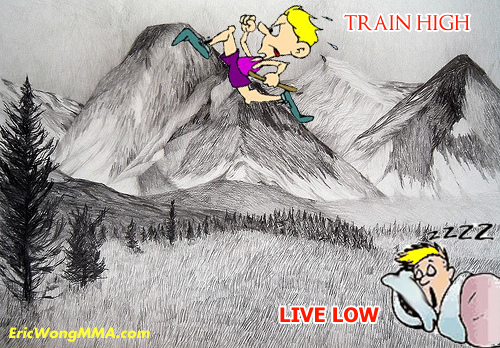
So we’re going to focus on the studies that test LLTH and forget about the rest.
[For now, maybe if you’re really interested, I’ll discuss the others a future post. Let me know in the Comments if this is something you’d be interested in reading]
In a paper I found titled, “Is Hypoxia Training Good for Muscles and Exercise Performance?” authors Michael Vogt and Hans Hoppeler from the University of Bern in Switzerland state quite definitively:
“… A common feature of virtually all studies on “live low–train high” is that hypoxic exposure only during exercise sessions is not sufficient to induce changes in hematologic parameters. Hematocrit and hemoglobin concentrations usually remain unchanged with “live low–train high.”
“What does this mean for YOU as a Mixed Martial
Artist Looking for Peak Performance?“
So, do these devices actually increase red blood cell production and improve oxygen delivery to your working muscles as claimed?
When Vogt and Hoppeler talk about “hematocrit” and “hemoglobin”, they’re basically talking about RBCs. For your purposes, hematocrit = hemoglobin = RBCs. For each, more is better.
If you don’t know what RBCs, hematocrit or hemoglobin are, here are some definitions:
[features_box_azure_blue width=”75%” + border=”2px”]Red Blood Cells
Cells in your body that are responsible for transporting oxygen where required; the more red blood cells (RBCs) you have, the more oxygen you can transport to working muscles
Hematocrit
Refers to the % of total blood that is made up of RBCs; more is better (to a point, if your blood gets too ‘thick’ you could die but this will never happen through training, only drugs)
Hemoglobin
The specific component of a RBC that carries the oxygen.
Let’s do an analogy – it’s kind of like if you were carrying a backpack that had your boxing gloves in them, you are the RBC and yes, you’re carrying your boxing gloves, but to be more precise, your backpack is actually carrying your gloves…
Well, your backpack is like Hemoglobin. Get it?
If not, I don’t blame you, the analogy sucked. Leave me alone – it’s late.[/features_box_azure_blue]
So Vogt and Hoppeler state that LLTH (altitude training) does NOT improve red blood cell paramaters, which means that performance does not improve either. But let’s look at some hard data, just to make sure, OK?
There are no studies on MMA specifically, so I had to search LONG and HARD to find something that would at least come close.
This took me FOREVER, because most of these altitude studies are done on endurance sport athlete such as runners, cyclists and cross-country skiers.
But lo and behold, I stumbled upon one, a moment before my eyes were about to explode from reading these cryptic journal articles all day. Scientists reading this – why can’t you write in normal English!

AND this is where we have today’s cliffhanger… 😛
I put a lot of work into this article, as you can tell from this first half…
So if you want the Conclusion, I want to see 100 Comments letting me know that you want to see it, otherwise, into the vault it goes!
I’m 100% serious – if we don’t get at least 100 Comments, you won’t see Part II.
– Eric
P.S. I give you the straight goods about the various altitude simulation devices, so if you want to know if it will improve your performance or not plus some extra data I uncovered from an unlikely source, leave a Comment below:
————– PART II ————–
We quickly got 100+ Comments, so here’s Part II of the Altitude Training Simulation Devices.